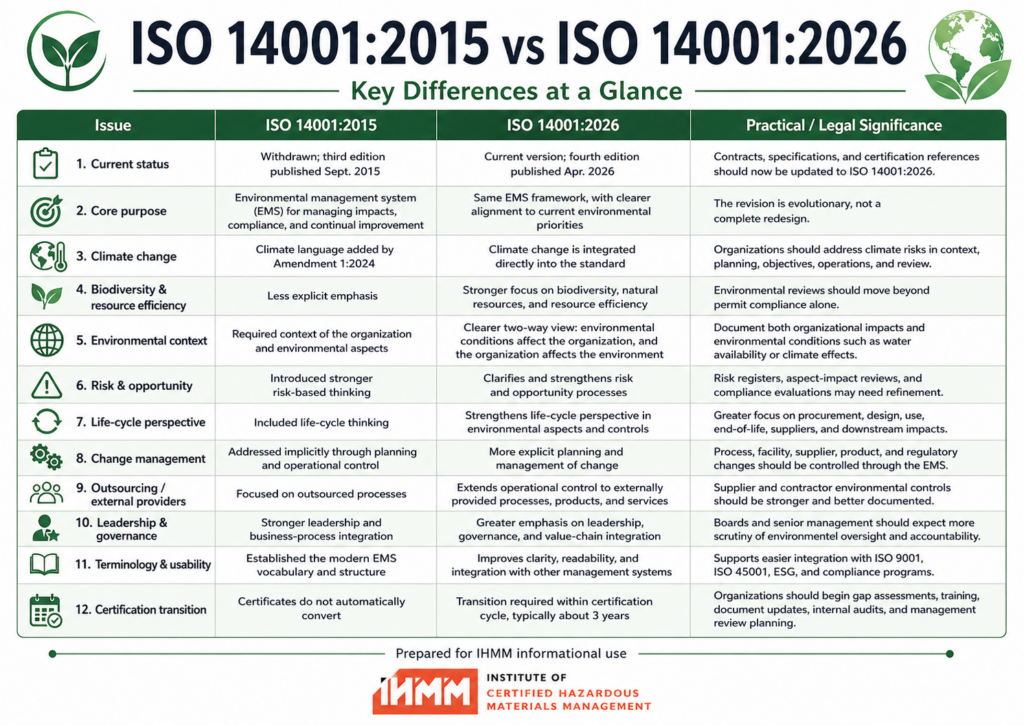

ISO 14001 matters because environmental compliance is no longer a narrow facilities function; it is an enterprise legal-risk, governance, procurement, and reputation issue. The 2026 edition strengthens that reality. By requiring a disciplined environmental management system, ISO 14001 gives organizations a defensible framework to identify environmental aspects, evaluate compliance obligations, assign responsibility, control operations, measure performance, audit results, and drive continual improvement. ISO 14001 is the cornerstone of IHMM’s AHMM, CHMM, and CHMP credentials.
For counsel, executives, and environmental professionals, the standard is important because it converts good intentions into documented evidence of due diligence. In enforcement, contracting, insurance, supply-chain review, and ESG scrutiny, an organization that can show a functioning ISO 14001 system is better positioned to prove that it understands its risks and manages them systematically.
The 2026 revision is especially timely. It places clearer emphasis on climate change, biodiversity, resource efficiency, leadership, governance, life-cycle thinking, and value-chain impacts. Those issues increasingly define both regulatory exposure and market access.
ISO 14001 is not a substitute for legal compliance. It is the management architecture that helps make compliance reliable, repeatable, auditable, and credible. For IHMM certificants and environmental professionals, it confirms their central role in protecting organizations, communities, and the environment.