

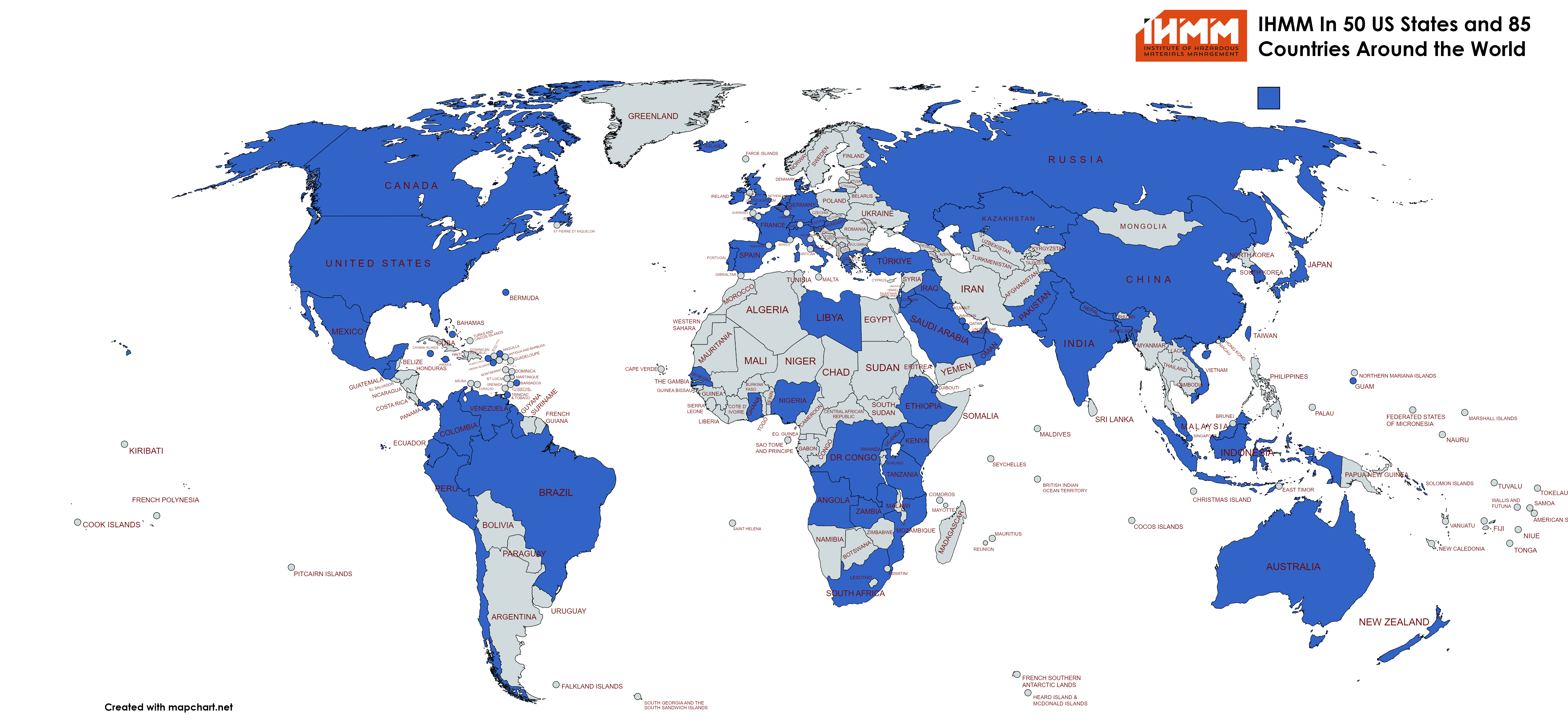
IHMM Global DG Transport Compliance Matrix (2025–2026)
IHMM Certificant Compliance Checklist
Week of January 25, 2026
Executive Overview
The period January 19–25, 2026 reflects a mature enforcement phase in global dangerous-goods regulation. With ADR 2025 fully settled, IMDG Code Amendment 42-24 mandatory worldwide, and ICAO Technical Instructions / IATA DGR 2026 in force, regulatory authorities are emphasizing inspection consistency, documentation accuracy, and alignment with UN Model Regulations, rather than issuing new treaty text.
Across all regions, regulatory risk during this week arises primarily from how existing instruments are applied, especially for battery technologies (lithium-ion and sodium-ion), hazardous waste, pressure receptacles, and undeclared DG in parcel and e-commerce channels.
II. United States — PHMSA Enforcement Continues to Define the Standard of Care
A. Enforcement Activity Without New Rulemaking
No amendments to 49 C.F.R. Parts 171–180 were published during this week. Nonetheless, the Pipeline and Hazardous Materials Safety Administration (PHMSA) continues to apply its data-driven inspection and enforcement framework, now firmly embedded in field operations.
During the week of January 19–25, PHMSA activity continued to concentrate on:
Lithium-ion and sodium-ion batteries, including battery-powered equipment and vehicles;
Pressure receptacles, particularly cylinder manufacture, requalification, and testing;
Undeclared or misdeclared hazardous materials, notably in parcel, courier, and e-commerce shipments; and
Repeat violators, identified through historical inspection and incident data.
Legal Significance
From a legal standpoint, PHMSA’s posture confirms that enforcement policy operates as de facto regulation. Although the Hazardous Materials Regulations have not changed textually, regulated parties—especially exporters—are now expected to demonstrate functional equivalence with UN Model Regulations and ADR-aligned practices in classification, packaging, documentation, and training. Non-alignment increasingly exposes entities to enforcement action, contractual disputes, and insurance coverage challenges.
III. Europe — ADR 2025 Fully Normalized; Preparations for ADR 2027 Continue
A. ADR 2025 as Settled Law
By late January 2026, ADR 2025 is fully normalized across Contracting Parties. During this week, European authorities continued routine inspections and issued operational clarifications addressing:
Correct application of new battery-related UN entries, including sodium-ion batteries;
Revised requirements for hazardous waste and asbestos transport;
Vehicle and equipment standards under ADR Part 9, particularly for alternative propulsion systems; and
Continued validity and recognition of ADR driver training certificates under Chapter 8.2.
- Last week, several members noted that in the IATA DGR 67th Edition, France changed the variation related to providing a 24-hour emergency response number. Here are the two published variations:2025 – FR-7The emergency response information described below must appear on shipments of dangerous goods to, from, within, or transiting through France. This does not apply to the transport of magnetized material or dangerous goods for which no transport document is required.
2026 – FR-7
On shipments to/from France, emergency response information as described hereafter must be provided on the shipper’s declaration or put on an external surface of packages containing dangerous goods for which no transport document is required.
- On shipments to, from, within or transiting through France, emergency response information as described hereafter must be provided on a transport document as per 5; 4.1.2:
- A telephone number by means of which emergency response information can be obtained in case of an incident and/or accident involving the dangerous goods being transported.
- This telephone number must be available 24 hours a day and must include the regional codes and, for international numbers outside France, the country and city codes needed to complete the call from France.
- This telephone number must be monitored at all times by a person who:
- is knowledgeable concerning the hazards and characteristics of the dangerous goods being transported;
- has comprehensive emergency response and accident mitigation information for the dangerous goods; and
- can immediately call upon a person who possesses such knowledge and information.
This provision does not apply to the transport of dangerous goods for which no transport document as per 5; 4.1.2 is required.
B. Informal Development of ADR 2027
At the UNECE Working Party on the Transport of Dangerous Goods (WP.15) level, preparatory work for ADR 2027 continues. Emerging topics include:
DG carriage by battery-electric and hybrid heavy vehicles;
Regulation of reverse logistics and returned dangerous goods;
Possible refinement of limited quantity (LQ) provisions; and
Enhanced treatment of undeclared DG in parcel and e-commerce distribution networks.
Legal Significance
For European and international operators, the message is clear: ADR 2025 tolerance periods have expired. Contracts, SOPs, and training programs should already incorporate change-management mechanisms anticipating further tightening in ADR 2027, particularly in battery-driven and consumer-distribution contexts.
IV. Asia — Mandatory Global Codes Drive Compliance Despite Legislative Quiet
A. Absence of New National DG Legislation
No major DG transport statutes or regulations were promulgated in key Asian jurisdictions during this week.
B. Carrier- and Port-Driven Compliance Environment
Operationally, however, the compliance landscape has shifted decisively because:
IMDG Code Amendment 42-24 is mandatory worldwide;
ICAO Technical Instructions / IATA Dangerous Goods Regulations 2026 are fully operative for air transport; and
Ocean carriers and ports are enforcing UN-aligned battery, waste, and documentation requirements without transitional leniency.
Legal Significance
In Asia, carrier and port acceptance criteria effectively define compliance. From a legal-risk perspective, UN- and ADR-aligned classification, packaging, labeling, and documentation now constitute the minimum standard of care, even where domestic legislation has not yet been formally updated.
V. Africa — Practical Convergence with UN and ADR Standards
A. No New DG Statutes Issued
No African jurisdiction enacted a significant DG-specific statute during the week of January 19–25.
B. Enforcement and Trade Practice Drive Alignment
Nonetheless, African ports, customs authorities, and transport operators continue to tighten DG controls by:
Requiring documentation consistent with UN classification and numbering;
Applying IMDG 42-24 standards for maritime shipments; and
Increasing scrutiny of battery and hazardous-waste consignments.
Legal Significance
For multinational operators, Africa exemplifies a broader trend: practice is converging toward UN/ADR standards ahead of legislation. Compliance failures increasingly manifest as shipment delays, refusals, or commercial disputes, rather than formal citations, but the legal and financial consequences remain substantial.
VI. Central & South America — MERCOSUR Stability, National Enforcement Emphasis
A. Regional Framework Remains Unchanged
At the regional level, no new MERCOSUR DG decisions were adopted during this week. The controlling instrument remains the MERCOSUR Agreement on the Land Transport of Dangerous Goods, as modernized by CMC Decision 15/2019, which is expressly tied to the UN Model Regulations.
B. National Enforcement and Interpretation
More consequential are national-level developments observed across the region:
Argentina continues intensified inspections of battery-powered equipment and vehicles under its UN-aligned implementation regime;
Brazil applies clarified guidance under ANTT Resolution 5.998/2022 for sodium-ion batteries and updated UN entries; and
Colombia maintains active enforcement of its dangerous-goods transport registry, with reporting and traceability obligations firmly in place.
Legal Significance
While MERCOSUR provides a harmonized technical baseline, compliance exposure is increasingly national and enforcement-driven. Shippers must ensure alignment with each country’s implementing measures, inspection practices, and reporting systems, not merely the regional agreement.
VII. Overall Assessment
For the week of January 19–25, 2026, global DG regulation is characterized by:
Enforcement-led evolution without new statutory text (United States, South America);
Full operational consolidation of ADR 2025 (Europe);
Mandatory application of IMDG 42-24 and ICAO/IATA 2026 (Asia and globally); and
Rising reliance on UN/ADR standards as the de facto global benchmark (Africa and emerging markets).
Across all regions, battery technologies, hazardous waste, pressure receptacles, and undeclared DG remain the principal regulatory pressure points.
VIII. Conclusion
As of late January 2026, dangerous-goods transportation law is defined less by new rulemaking than by how existing rules are enforced and harmonized internationally. For IHMM certificants and DG professionals, the prudent course is to treat PHMSA enforcement priorities, ADR 2025, the UN Model Regulations, IMDG Code Amendment 42-24, and ICAO/IATA 2026 as the operative global standard of care. Documentation accuracy, packaging approvals, training currency, and contractual controls should be reviewed accordingly as the 2026 compliance year advances.

Leave A Comment