
ISO 45001 remains the international benchmark for occupational health and safety management systems. Its importance lies not in creating another paperwork exercise, but in giving employers a disciplined legal and operational framework for identifying hazards, controlling risk, involving workers, meeting legal obligations, preparing for emergencies, investigating incidents, and continually improving safety performance.
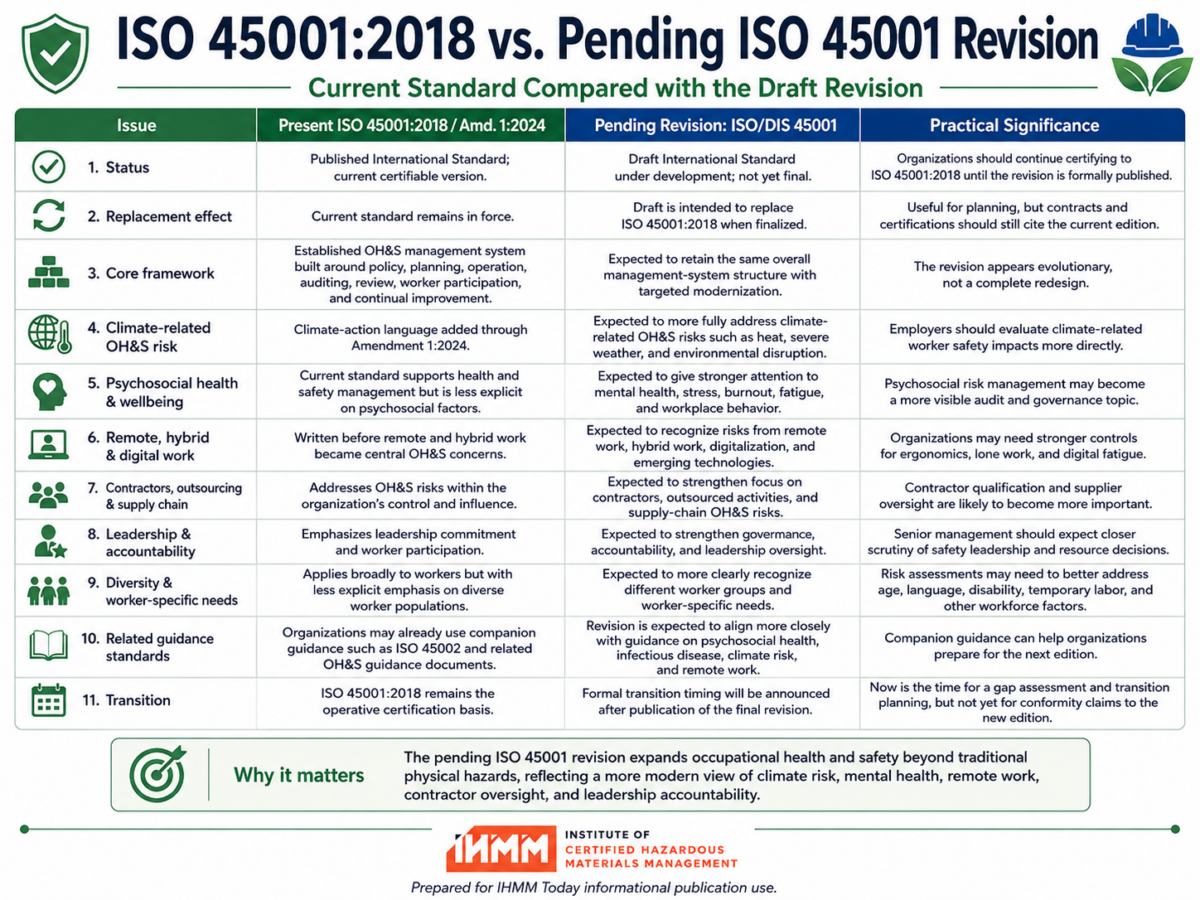
The pending revision of ISO 45001 signals that workplace safety is expanding beyond traditional physical hazards. Emerging expectations include stronger treatment of psychosocial risks, mental health, workplace culture, climate-related safety impacts, hybrid work, digital work environments, contractor control, supply-chain risk, leadership accountability, and the differing needs of diverse worker populations.
For employers, this matters because ISO 45001 can serve as evidence of due diligence, reasonable care, and systematic risk management. For safety professionals, it elevates their role from compliance support to enterprise risk leadership. For credential holders in safety, health, environmental, and hazardous materials disciplines, the revised standard will likely increase demand for professionals who can translate broad management-system requirements into practical workplace controls.
Organizations should begin preparing now through gap assessments, leadership briefings, contractor reviews, and stronger integration of health, safety, climate, and workforce-risk planning.