

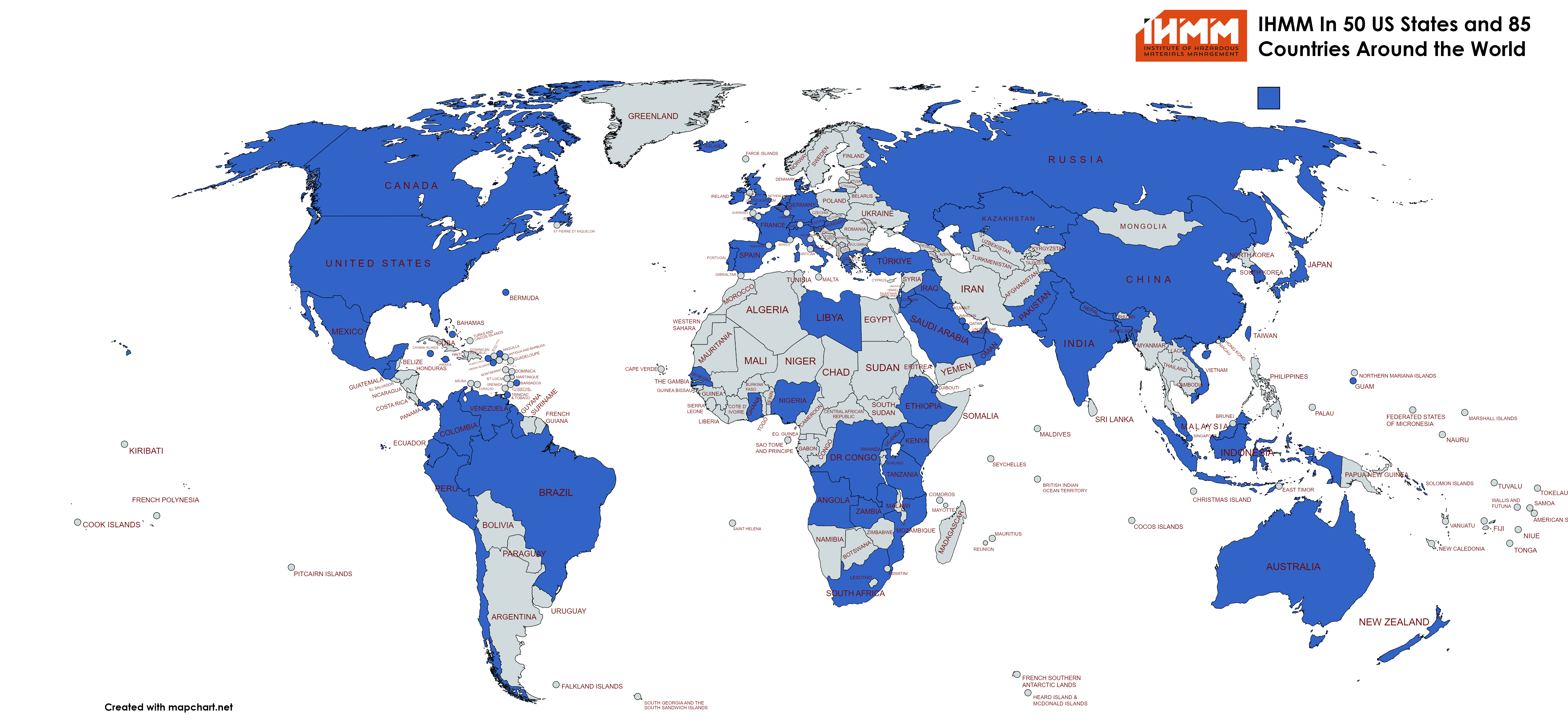
IHMM Global DG Transport Compliance Matrix (2026-UPDATED)
IHMM Certificant Compliance Checklist (2026-UPDATED)
July 15-21, 2026
IHMM Issues Updates to the Global DG Transport Compliance Matrix and the IHMM Certificant Compliance Checklist
United States, Canada, and Mexico
For the period of July 15–21, 2026, dangerous-goods and hazardous-materials transportation policy across North America continued to develop through special-permit activity, pipeline-safety rulemaking, technical-standards modernization, digital compliance systems, and continuing implementation of international dangerous-goods recommendations.
Because this article is prepared on July 20, references to July 21 are limited to scheduled or previously announced actions.
United States
PHMSA Opens New Special-Permit Dockets
The most significant package-hazmat development entering this reporting period was PHMSA’s July 14 publication of three special-permit notices: applications for new permits, applications to modify existing permits, and agency actions granting or denying permit requests.
Comments on new applications and actions are due August 13, while comments on proposed modifications are due July 29.
Special permits are an important component of the federal hazardous-materials system because they allow PHMSA to authorize transportation that differs from the literal requirements of 49 C.F.R. Parts 171–180 where the applicant demonstrates an equivalent level of safety. They are frequently used for innovative packaging, pressure receptacles, battery systems, specialized industrial operations, and emerging technologies.
The legal protection afforded by a special permit is narrow. It extends only to authorized parties acting within the permit’s precise conditions. Training, packaging, documentation, marking, operational controls, and recordkeeping requirements contained in the permit are enforceable obligations.
Pipeline-Safety Rulemaking and Integrity Management
PHMSA also continued substantial pipeline-safety activity affecting hazardous liquids and natural gas. A pending proposal would revise repair criteria for hazardous-liquid and gas-transmission pipelines, including more stringent treatment of cracks reaching specified percentages of pipe-wall thickness.
In addition, PHMSA issued guidance intended to improve distribution-integrity-management risk evaluations. The guidance emphasizes high-risk infrastructure, interacting threats, leak-management effectiveness, and the use of appropriate risk models.
These actions are not package-shipping amendments, but they remain part of the broader law governing transportation of hazardous materials and energy products. Pipeline operators should expect continued regulatory focus on traceable records, condition assessment, risk prioritization, leak response, and timely remediation.
Pipeline Advisory Committee Meeting Announced
On July 17, PHMSA announced that its Gas Pipeline Advisory Committee and Liquid Pipeline Advisory Committee will meet jointly on July 30 to consider pending notices of proposed rulemaking.
The meeting is legally significant because the advisory committees provide technical review and recommendations before PHMSA advances major pipeline-safety rules. Operators and interested stakeholders should review the underlying dockets and consider participating before the announced registration deadline.
Hazardous-Materials Interpretations
PHMSA’s recent interpretation activity also remains relevant. In one interpretation, the agency clarified application of a testing exception for certain safety devices, including seatbelt pretensioners containing tested airbag inflators. In another, PHMSA addressed regulatory questions involving hazardous-materials operations for modular industrial equipment.
Interpretation letters do not amend the HMR and are binding only on the specific facts presented. Nevertheless, they provide valuable guidance concerning how PHMSA reads existing requirements and can be useful when developing internal procedures.
Registration and Digital Administration
The 2026–2027 hazardous-materials registration cycle remains underway. PHMSA continues modernizing registration, approvals, and compliance administration through digital platforms.
Regulated entities should verify that registration records accurately reflect their legal name, business activities, ownership structure, fee category, and locations. Inaccurate digital records can create enforcement issues independent of the underlying shipment.
Canada
Highway-Tank Standards Under Development
Canada continues modernizing the technical standards incorporated into its Transportation of Dangerous Goods Regulations. A new edition of CSA B620, governing highway tanks and TC portable tanks, remains under development for expected publication in 2026.
The draft update is being coordinated with related standards CSA B621 and CSA B622. These standards govern the design, construction, certification, assembly, modification, repair, inspection, testing, maintenance, and marking of highway tanks and portable tanks used to transport dangerous goods.
This process is legally significant because Canada incorporates technical standards by reference. A revised standard can therefore become part of the binding TDG compliance framework without rewriting every technical requirement directly into the regulations.
Operators using cargo tanks or TC portable tanks should maintain a controlled system for identifying:
- The edition incorporated into the TDG Regulations;
- Applicable transition periods;
- Inspection and test intervals;
- Repair and modification requirements;
- Facility and personnel registration obligations;
- Required tank markings and certification records.
TDG Modernization Continues
Transport Canada’s forward regulatory plan continues to identify international harmonization, technical updates, training competency, electronic shipping documents, and means-of-containment requirements as continuing priorities.
Canada’s policy direction reflects increasing reliance on risk-based oversight and international collaboration, particularly for batteries, energy-storage systems, means of containment, and emergency response.
CANUTEC and Incident Reporting
CANUTEC remains Canada’s 24-hour emergency center for dangerous-goods incidents. Canadian consignors may register to use CANUTEC’s emergency telephone number on shipping documents.
Regulated entities should maintain written procedures for releases, anticipated releases, thefts, losses, collisions, evacuations, and transportation closures that may trigger reporting under Part 8 of the TDG Regulations.
Canadian Legal Assessment
No major new TDG amendment or significant Canada-specific dangerous-goods transportation accident was identified for July 15–20. Canada’s material developments during this period were therefore primarily standards-development and implementation matters.
Mexico
UN-Aligned Standards Modernization Continues
Mexico continues operating under a national dangerous-goods framework substantially based on the UN Recommendations, implemented through the Reglamento para el Transporte Terrestre de Materiales y Residuos Peligrosos and supporting NOMs.
No major new dangerous-goods NOM was identified as published during July 15–20. However, the country’s standards program continues to include modernization of dangerous-goods lists, packaging, limited quantities, containment, and fuel transportation.
For cross-border operators, harmonization does not eliminate national differences. A proper shipping name, exception, special provision, or identification number accepted in the United States or Canada is not automatically valid under Mexican law.
LP-Gas and Petroleum Transportation
Mexico’s continuing regulatory priority remains transportation of liquefied petroleum gas and petroleum products following the deadly 2025 Mexico City tanker explosion and subsequent fuel-related incidents.
Expected enforcement areas include:
- Tank and vehicle condition;
- Hydrostatic and periodic testing;
- Driver qualifications;
- Insurance and carrier authorization;
- Speed and route controls;
- GPS and continuous monitoring;
- Emergency equipment and response plans;
- Documentation establishing lawful possession of the cargo.
Limited-Quantity Controls
Mexico also continues modernizing its approach to dangerous goods transported in limited quantities. Limited-quantity relief is conditional rather than automatic. A shipment that exceeds quantity limits or fails to satisfy packaging and marking conditions may become fully subject to the dangerous-goods rules.
Cross-border shippers should conduct a Mexico-specific review before relying on a domestic limited-quantity exception.
Mexican Legal Assessment
No comparably significant, independently verified Mexican dangerous-goods transportation accident or new national rule was identified for July 15–20. The principal developments remained implementation of existing fuel-safety controls and continued standards modernization.
North American Legal Themes
Several themes define this reporting period.
First, regulatory innovation continues through special permits and technical standards rather than through omnibus legislation.
Second, pipeline integrity remains a major component of hazardous-materials transportation law, particularly where cracks, leaks, interacting threats, and aging infrastructure are concerned.
Third, digital administration is becoming part of the enforcement system. Registration, approvals, permits, electronic documents, and incident data are increasingly interconnected.
Fourth, means-of-containment integrity remains central. Highway tanks, portable tanks, pressure receptacles, and associated inspection records are receiving continuing regulatory attention.
Fifth, international harmonization remains influential but incomplete. The United States, Canada, and Mexico all rely substantially on UN-based standards while retaining nationally specific rules, exceptions, enforcement systems, and documentation requirements.
Conclusion
For July 15–21, 2026, North American dangerous-goods transportation law was defined by active special-permit dockets, pipeline-safety rulemaking, Canadian tank-standard modernization, and continuing Mexican fuel and LP-gas oversight.
For regulated entities, the modern standard of care requires current registration, defensible classification, precise compliance with special permits, version-controlled technical standards, documented tank and vehicle integrity, competent personnel, immediate incident-response procedures, and jurisdiction-specific review of cross-border shipments.
Dangerous-goods compliance is increasingly an integrated legal and operational system. Organizations that treat permits, technical standards, electronic records, asset integrity, and emergency response as separate functions risk creating gaps that regulators may view as systemic compliance failures.
PHMSA published notices covering new special-permit applications, modifications, and actions on July 14. Comments on new applications and actions close August 13; modification comments close July 29.
PHMSA’s proposed pipeline repair criteria would revise the regulatory treatment of significant crack depths, while its distribution-integrity-management bulletin emphasizes high-risk infrastructure, interacting threats, leak management, and suitable risk models.
The Gas and Liquid Pipeline Advisory Committees are scheduled to meet jointly on July 30, 2026, to review pending proposals.
Transport Canada states that a new edition of CSA B620 is under development for 2026 and describes the standard’s requirements for highway tanks and TC portable tanks. CANUTEC remains Canada’s 24-hour emergency center, and Canada’s TDG program continues to emphasize safety standards, risk-based oversight, emergency response, and international collaboration.
PHMSA’s Mexico guidance confirms that Mexico’s land-transport hazardous-materials framework is based substantially on the UN Recommendations but implemented through nationally specific regulations and NOMs.
Europe, Africa, Asia, and South America
For the period of July 15–21, 2026, dangerous-goods and hazardous-materials transportation policy across Europe, Africa, Asia, and South America remained focused on implementation of existing international requirements, preparation for the next UNECE amendment cycle, digital freight traceability, battery-fire risks, and the security of tankers carrying petroleum, chemicals, and other dangerous cargoes.
No new edition of ADR or the UN Model Regulations entered into force during this reporting period. Nevertheless, regulated entities continued to face significant operational and legal developments under ADR 2025, the IMDG Code, the ICAO Technical Instructions, national dangerous-goods laws, and electronic freight-control systems.
International Regulatory Framework
The 68th Session of the United Nations Sub-Committee of Experts on the Transport of Dangerous Goods concluded on July 8. Consequently, the July 15–21 period represents the beginning of the post-session review phase, during which governments, industry organizations, and modal regulators assess the session’s proposals and decisions for possible incorporation into later editions of the UN Model Regulations.
The next UNECE dangerous-goods meetings include an ADN Joint Meeting of Experts scheduled for August 24–28 and the 120th session of the Working Party on the Transport of Dangerous Goods, WP.15, scheduled for November 3–6. A September 2026 RID/ADR/ADN Joint Meeting listed by UNECE has been cancelled.
The legal significance is that amendments affecting classification, packaging, portable tanks, batteries, pressure receptacles, documentation, and emerging technologies generally move through several stages before becoming binding. Businesses should therefore monitor the UN and UNECE process before a proposal reaches the final national-implementation stage.
Europe
ADR 2025 Remains the Controlling Road-Transport Standard
ADR 2025 remains applicable to international road transportation of dangerous goods among its Contracting Parties. Its requirements govern classification, packaging, tank construction, marking, labeling, placarding, documentation, vehicle equipment, driver training, security, and emergency instructions.
The current period is principally one of implementation rather than enactment. European consignors, carriers, packers, loaders, fillers, tank operators, and consignees should ensure that internal manuals, transport documents, software systems, driver instructions, and Dangerous Goods Safety Adviser procedures reflect the 2025 text.
Under ADR, vehicle crews must be informed of the dangerous goods loaded and must consult the required written instructions concerning actions to take during an accident or emergency.
Multilateral Agreements Continue to Require Careful Review
UNECE continues to maintain ADR multilateral agreements that temporarily permit specified deviations from the ordinary ADR text among countries that have signed the particular agreement. These agreements may address matters such as the carriage of vehicles under particular special provisions.
A multilateral agreement is not universally applicable throughout Europe. Its relief ordinarily depends upon the countries involved, the validity period, and strict compliance with the agreement’s conditions.
Companies should therefore avoid treating an ADR multilateral agreement as a general exemption. Before relying upon one, counsel or the Dangerous Goods Safety Adviser should confirm that every relevant country is a signatory and that the proposed movement falls within the agreement’s precise scope.
Dangerous Goods Safety Advisers
European and United Kingdom businesses involved regularly in consigning, packing, filling, loading, unloading, or transporting dangerous goods generally remain subject to Dangerous Goods Safety Adviser requirements. Current United Kingdom guidance emphasizes that the adviser’s responsibilities include accident investigation, regulatory compliance, and prevention of risks to people, property, and the environment.
The DGSA function should not be treated merely as an annual-reporting exercise. The adviser should participate in classification decisions, contractor oversight, training, incident reviews, security planning, and management-of-change procedures.
Maritime Energy-Supply Risks
Attacks on tanker traffic in and around the Strait of Hormuz continued to affect European energy and chemical supply chains during this reporting period. Reuters reported that shipping attacks and military escalation had increased oil prices, insurance costs, freight rates, and concern over interruptions to tanker movements.
Although the physical incidents occurred outside Europe, European charterers, refiners, chemical companies, ports, and cargo interests remain exposed through delayed deliveries, vessel deviation, increased war-risk premiums, and possible shortages.
Asia
Chemical and Petroleum Tanker Security
Maritime security remained the most significant dangerous-goods issue affecting Asia and the Middle East. On July 14, immediately preceding this reporting period, the chemical tanker Stolt Magnesium was reportedly struck by an external explosion off Oman, causing a fire aboard the vessel.
Additional tanker attacks in the Strait of Hormuz reportedly caused fires, crew casualties, evacuations, and significant vessel damage.
These incidents have direct legal implications under the IMDG Code, the International Safety Management Code, maritime-security requirements, charter parties, bills of lading, marine-insurance policies, and the general duty to exercise due diligence regarding seaworthiness and voyage safety.
Operators moving petroleum, LNG, chemicals, or other dangerous cargoes through conflict-affected waters should review:
- Voyage and route-risk assessments;
- War-risk insurance and notification requirements;
- Emergency shutdown and fire-control systems;
- Cargo-containment integrity;
- Crew evacuation and abandonment procedures;
- Salvage and emergency-towing arrangements;
- Ports of refuge;
- Contractual rights to deviate, suspend, or terminate a voyage.
Compliance with technical cargo rules does not relieve an operator of the separate responsibility to assess whether the route itself presents an unacceptable threat.
Lithium Batteries and Air Transportation
Lithium-ion batteries in personal electronic devices and cargo remain a growing aviation concern. Recent reporting indicates that overheating events involving power banks, phones, electronic cigarettes, and other passenger devices are occurring with increasing frequency, prompting airlines to strengthen restrictions on storage, charging, and carriage.
IATA’s Dangerous Goods Regulations continue to provide the principal operational standard used by airlines, freight forwarders, ground handlers, and shippers to classify, pack, mark, label, and document dangerous goods offered for air transportation.
Asian manufacturers and exporters should maintain evidence of:
- UN 38.3 testing;
- Battery-test summaries;
- Correct watt-hour or lithium-content determinations;
- Applicable state-of-charge restrictions;
- Protection against short circuits and activation;
- Proper inner and outer packaging;
- Carrier-specific acceptance requirements.
Misdeclared batteries may expose the shipper to regulatory penalties, carrier claims, cargo rejection, emergency-response costs, and substantial civil liability if a fire occurs.
Growth in Battery-Powered Vehicle Exports
China’s automobile exports continued expanding during July, including exports of battery-powered vehicles.
The growth of vehicle exports increases the importance of correctly applying maritime provisions governing vehicles powered by lithium-ion, sodium-ion, and other battery systems. Shippers must determine whether batteries are installed securely, whether damage or defects are present, whether the vehicle qualifies for an applicable special provision, and whether carrier-specific declaration requirements exceed the minimum regulatory standard.
Africa
Existing National and International Requirements Remain Controlling
No major continent-wide dangerous-goods enactment was identified for July 15–20. African dangerous-goods transportation remains governed primarily through national road, rail, port, aviation, environmental, and customs systems that frequently draw upon the UN Model Regulations, the IMDG Code, and the ICAO Technical Instructions.
South Africa’s Department of Transport continues to require dangerous-goods packaging to be tested, certified, and permanently marked by an authorized national testing and certification laboratory.
The practical compliance burden therefore includes more than possession of a shipping document. Operators must verify the validity of packaging certifications, vehicle suitability, driver training, emergency information, placarding, segregation, and any permits required by port or environmental authorities.
Fuel-Tanker Risk Remains a Major Concern
Africa has experienced repeated fatal fuel-tanker accidents, frequently involving overturned vehicles, spilled petroleum, public gathering at the scene, and subsequent ignition. Although no comparably significant new Africa-specific accident was independently verified for July 15–20, the historical pattern demonstrates the need for strengthened tanker integrity, route management, public-exclusion procedures, driver competency, and rapid emergency response.
The absence of a major new enactment during this week should not be interpreted as an absence of legal exposure. Carriers may face liability under transportation, occupational-safety, environmental, road-traffic, and general negligence laws even where domestic dangerous-goods provisions are less detailed than ADR.
Port and Carrier Requirements
For international African trade, the most immediate enforcement point may be the port, vessel operator, airline, or terminal rather than a roadside authority. Cargo may be rejected for inaccurate dangerous-goods declarations, inadequate packaging certification, improper segregation, or failure to satisfy the carrier’s more restrictive conditions.
South America
Colombia Expands RNDC Implementation
Colombia continued implementing its updated Registro Nacional de Despachos de Carga framework during this reporting period. On July 16, the Ministry of Transport conducted training concerning the registration of logistics times under Resolution No. 20263040016075.
The resolution consolidates and updates the RNDC legal framework and contains specific provisions for registering information concerning dangerous goods. Applicable records must identify the nature of the goods, packaging conditions, shipment details, and dangerous-goods information required by the system.
Updated RNDC guidance dated July 14 also addressed electronic consignment records and related data fields.
Legal Significance of Digital Freight Records
Colombia’s approach illustrates a broader shift from paper-based roadside inspection toward data-driven regulatory oversight. Electronic records permit authorities to compare:
- UN numbers and descriptions;
- Cargo quantities;
- Shippers and consignees;
- Vehicles and carriers;
- Routes and travel times;
- Freight manifests;
- Driver qualifications;
- Environmental or waste documentation.
An inaccurate electronic entry may become evidence of a classification, documentation, contractual, or environmental violation. Companies should therefore apply the same legal review and quality-control procedures to RNDC entries that they apply to formal transport documents.
Brazil’s Dangerous-Products Framework
Brazil continues regulating road transport of dangerous products through ANTT Resolution No. 5.998/2022 and related technical requirements. The regulation requires suitable vehicles and transportation equipment and prohibits the use of equipment presenting contamination that could create an unsafe condition.
ANTT’s statutory authority includes establishing technical and operational standards for dangerous-products transportation by road and rail.
Brazil also began automatic verification of mandatory cargo-transport insurance during July 2026. Although the insurance initiative is not limited to dangerous goods, it is important for hazardous-products carriers because failure to maintain verifiable insurance may compound liability following a spill, collision, fire, or environmental release.
Argentina and MERCOSUR
Argentina continues applying a national dangerous-goods framework structured substantially around UN recommendations and MERCOSUR inland-transport principles. Operators must nevertheless comply with Argentina’s specific driver, vehicle, documentation, inspection, and enforcement requirements.
Regional harmonization facilitates trade but does not eliminate national differences or allow a company to assume that a document or exception accepted in one MERCOSUR country is automatically sufficient in another.
Cross-Regional Legal Themes
Several themes define the July 15–21 reporting period.
First, the international system has entered a post-UNSCOE review phase. Governments and modal regulators are beginning to evaluate technical proposals for future implementation.
Second, ADR 2025 and existing modal instruments remain controlling. Businesses should not implement proposed UN provisions prematurely or assume they are already legally binding.
Third, maritime security has become inseparable from dangerous-goods risk management. Tanker attacks can create fire, explosion, pollution, crew-safety, insurance, and contractual consequences even where the cargo was properly classified and documented.
Fourth, batteries remain a principal source of regulatory and operational risk in air and maritime transportation.
Fifth, digital freight systems are becoming direct enforcement tools. Colombia’s RNDC system demonstrates how regulators can compare shipment data across carriers, vehicles, routes, and cargo records.
Sixth, international harmonization does not eliminate national law. ADR, IMDG, ICAO, UN recommendations, MERCOSUR instruments, and national regulations must be read together.
Conclusion
For July 15–21, 2026, dangerous-goods transportation law across Europe, Africa, Asia, and South America was characterized less by the adoption of major new codes than by active implementation, digitalization, maritime-security risk, and preparation for future international amendments.
Europe continues operating under ADR 2025 while monitoring the next UNECE meetings. Asia faces acute tanker-security and battery-transport challenges. Africa continues relying upon national implementation of UN, ICAO, and IMDG principles, with packaging certification and fuel-tanker safety remaining critical. South America is expanding data-driven freight oversight, particularly through Colombia’s RNDC system, while Brazil continues enforcing vehicle, equipment, and insurance requirements.
The modern legal standard of care requires more than correct labels and shipping papers. It demands defensible classification, version-controlled regulatory systems, accurate electronic records, tested packaging, current battery documentation, route-security analysis, appropriate insurance, competent personnel, verified containment integrity, and coordinated emergency-response planning.

Leave A Comment