

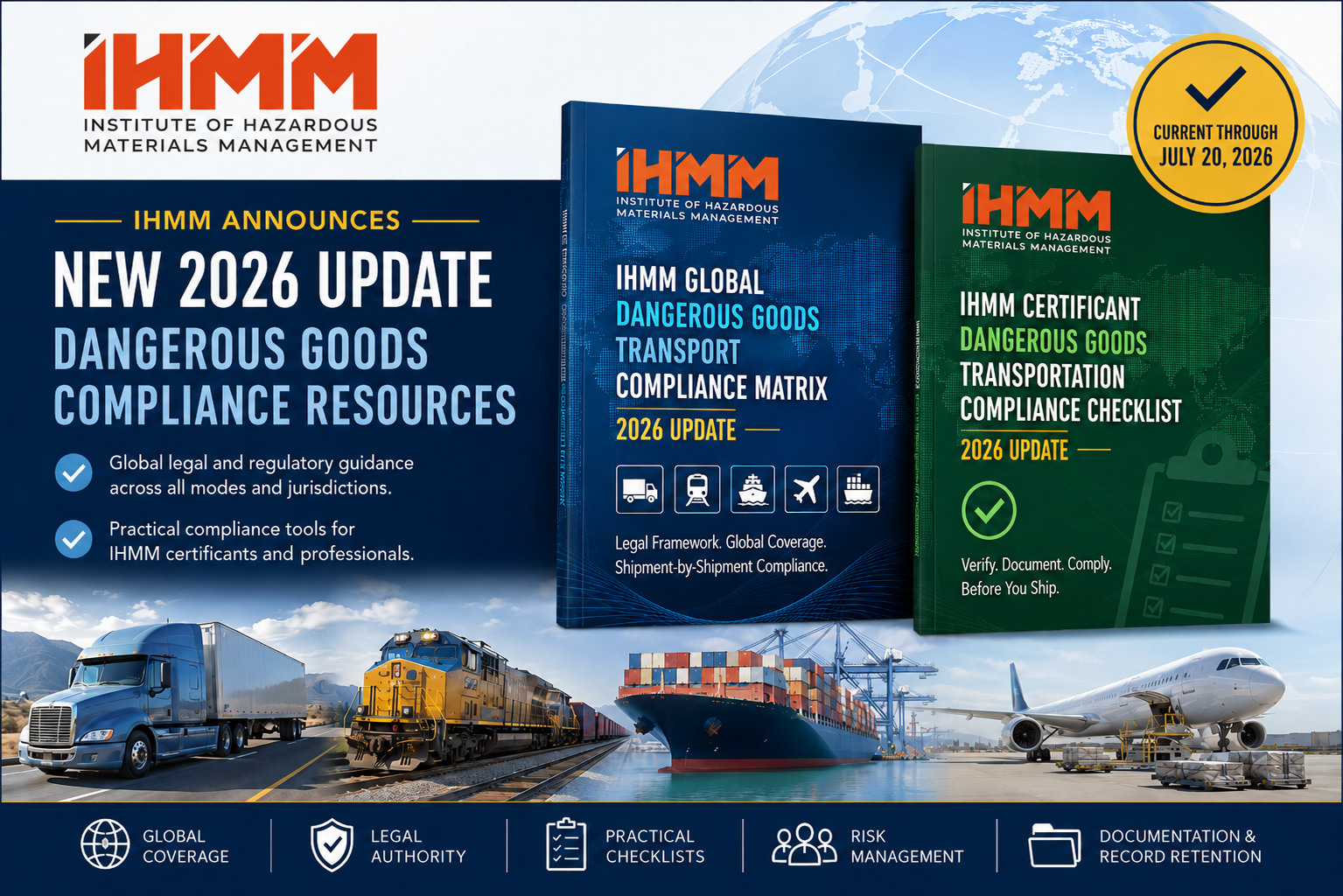
The Institute of Hazardous Materials Management has published two substantially revised dangerous-goods transportation resources designed to assist IHMM certificants and other qualified professionals in navigating the increasingly complex legal requirements governing domestic, international, and multimodal shipments.
The IHMM Global Dangerous Goods Transport Compliance Matrix—2026 Update and the IHMM Certificant Dangerous Goods Transportation Compliance Checklist—2026 Update replace earlier materials that no longer adequately reflected the governing regulatory environment. Both documents are current through July 20, 2026, and should be used together as complementary compliance and risk-management tools.
The new Global Compliance Matrix provides the legal architecture for determining which regulatory requirements apply to a particular shipment. Its most important principle is that dangerous-goods compliance is cumulative. A shipper must identify every domestic, international, transit, and destination leg; determine the governing law for each mode and jurisdiction; and satisfy applicable carrier, port, airport, terminal, permit, and competent-authority requirements. Compliance with one modal code does not necessarily establish compliance with the remaining portions of the journey. (IHMM)
The Matrix corrects several potentially consequential statements contained in the previous edition. Among other matters, it clarifies that:
- The current completed United States harmonization rule is HM-215Q. HM-215R, proposed on February 10, 2026, remains a proposed rule and should not be treated as final law.
- The United Nations Model Regulations, Revision 24, constitute a model framework for future harmonization and are not independently binding unless adopted by the controlling national, regional, or modal authority.
- IMDG Code Amendment 42-24 became mandatory on January 1, 2026.
- The 2025–2026 ICAO Technical Instructions must be applied together with current addenda, corrigenda, State variations, and operator variations.
- MERCOSUR CMC Decision 15/2019 entered into force on February 12, 2025, following incorporation by Argentina, Brazil, Paraguay, and Uruguay.
- The previously cited “JT/T 617-2024” reference for China was unsupported by the official standards listing reviewed and should not be used without further legal-source verification. (IHMM)
The Matrix also contains trade-lane analyses addressing movements between the United States, Europe, Asia, Africa, and MERCOSUR jurisdictions. These analyses identify the binding baseline, required modal and jurisdictional interface checks, and developments that compliance professionals should monitor. Particularly important is the Matrix’s recognition that neither Asia nor Africa is governed by a single, comprehensive regional dangerous-goods transportation code. National law, treaty participation, implementation measures, local permits, language rules, and carrier requirements must therefore be verified country by country. (IHMM)
A shipment-by-shipment operational control matrix translates these legal principles into ten documented controls, including route mapping, governing-law identification, classification reconciliation, packaging authorization, hazard communication, commodity-specific controls, personnel and equipment qualifications, carrier acceptance, change management, and record retention. For each control, the document identifies the required decision, minimum supporting evidence, and regulatory red flags.
The Certificant Compliance Checklist converts the Matrix’s legal framework into a practical shipment-planning and internal-audit process. It begins with a clear stop-work rule: a shipment should not be tendered or accepted when classification, packaging authority, required evidence, documentation, markings, training, permits, or carrier acceptance is missing or materially inconsistent. (IHMM)
The Checklist establishes twelve initial release hold points and then guides the certificant through the principal elements of a legally defensible compliance review, including:
- Identification of all regulated parties, shipment legs, jurisdictions, modes, and governing authorities;
- Classification and commodity-specific requirements;
- Packaging, tanks, intermediate bulk containers, cylinders, vehicles, and inspection controls;
- Shipping papers, declarations, emergency information, and document reconciliation;
- Marks, labels, placards, orange panels, and signage;
- Training, qualifications, permits, approvals, and registrations;
- Mode-specific requirements for road, rail, maritime, air, and inland-waterway transportation;
- Carrier, port, airport, terminal, and third-party acceptance;
- Security planning, emergency preparedness, and incident reporting; and
- Recordkeeping, auditing, corrective action, change control, and document retention.
The revised Checklist gives particular attention to lithium and sodium-ion batteries, damaged or defective batteries, prototypes, waste shipments, infectious substances, temperature-controlled materials, and other commodities subject to rapidly changing or highly specialized controls. It properly distinguishes between the required UN 38.3 test summary and a full laboratory test report, which need not accompany every shipment unless required by applicable law, a competent authority, a port, a carrier, or a contractual condition. (IHMM)
The Checklist also adds several important United States compliance baselines. These include two-year retention of non-waste hazardous-material shipping papers, three-year retention for hazardous-waste shipping papers, maintenance of required training records, annual review of applicable security plans, and notice of specified serious incidents as soon as practicable but no later than twelve hours. These are expressly presented as selected U.S. baselines; other jurisdictions, permits, waste laws, contracts, and management systems may impose different or longer requirements. (IHMM)
Professional Significance
Together, these documents establish a more disciplined and legally defensible method of dangerous-goods transportation management. They reject reliance on generalized summaries, unsupported assumptions, future harmonization proposals, or the proposition that compliance with an international model code automatically satisfies national law.
The documents instead emphasize contemporaneous verification, objective evidence, independent release review, formal modal handoffs, carrier acceptance, documented legal authority, and controlled retention of the exact regulatory editions, addenda, corrigenda, variations, and approvals used for each shipment.
For IHMM certificants, the Matrix answers the question, “What legal and regulatory systems govern this movement?” The Checklist answers the operational question, “What must be verified and documented before this shipment may proceed?”
These new resources reinforce the professional responsibility of IHMM certificants to exercise competent judgment, identify unresolved compliance questions, preserve evidence supporting their decisions, and stop transportation activities when material requirements have not been satisfied.

Leave A Comment