

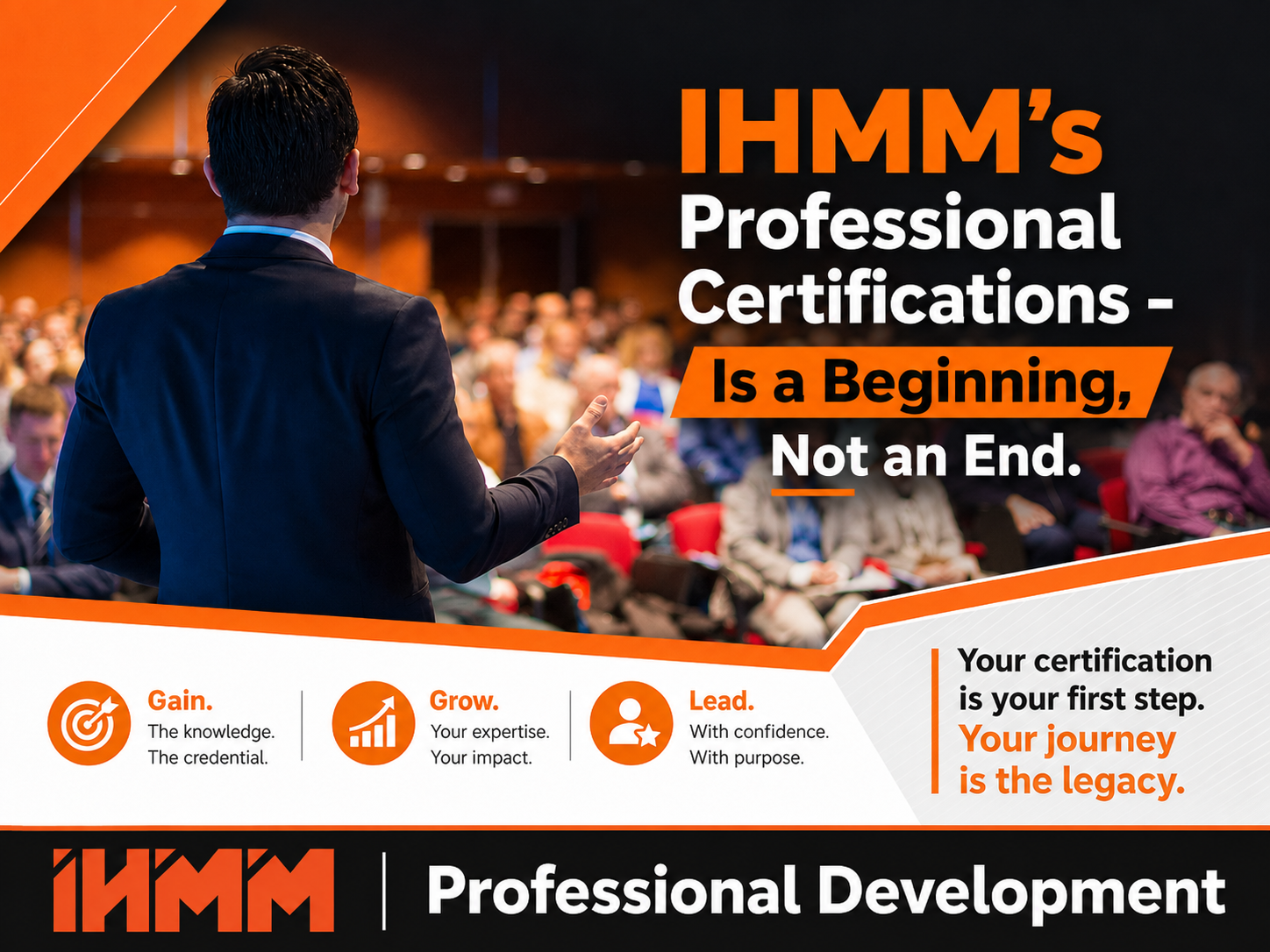
Earning an IHMM professional certification is a significant achievement. It demonstrates that an individual has satisfied established eligibility requirements, acquired a defined body of knowledge, and successfully met an independent standard of professional competence. Certification, however, should not be viewed as the final destination in a professional’s development. Rather, it marks the beginning of an ongoing commitment to continuous improvement, ethical practice, and professional growth.
The knowledge required to enter a profession does not remain static. Laws change. Regulations are revised. Standards are updated. Technologies evolve. New scientific information emerges, and accepted practices are continually tested against experience. A professional who relies exclusively on the knowledge possessed at the time of certification risks becoming less effective—and potentially less competent—as the profession advances.
For that reason, continuing professional development is an essential component of a credible certification program. Recertification requirements, certification maintenance points or credits, professional development activities, and competency-maintenance programs are not merely administrative obligations. They provide an organized means for certificants to demonstrate that their knowledge and skills remain current, relevant, and capable of meeting contemporary professional demands. That’s what the IHMM Foundation is all about, with more than 1,800 courses for our certifications > https://hazmatsociety.org/professional-development/
Professional development also reflects an important ethical principle: competence must be maintained, not simply attained. Employers, clients, regulators, colleagues, and members of the public frequently rely upon professional credentials as evidence that a certificant possesses specialized knowledge and exercises sound judgment. That reliance creates a continuing responsibility. A credential holder must be prepared not only to perform work competently but also to recognize changes in the law, technology, science, and professional practice that may affect how that work should be performed.
This responsibility is particularly important in professions involving public health, environmental protection, workplace safety, hazardous materials, risk management, and other areas in which professional decisions may have significant consequences. In these fields, outdated knowledge can contribute to regulatory violations, operational failures, injuries, environmental harm, financial loss, and reputational damage. Continuous learning is therefore more than professional enrichment; it is a practical risk-management obligation.
Professional development may take many forms. Formal education, technical courses, conferences, webinars, workshops, committee service, research, teaching, publishing, mentoring, and participation in professional organizations can all contribute to maintaining and expanding competence. The most valuable professional development activities are those that relate directly to a certificant’s responsibilities, address emerging issues, strengthen areas of limited experience, and improve the individual’s ability to serve employers, clients, and the public.
Continued learning also creates opportunities for professional advancement. Certificants who consistently expand their knowledge are better positioned to assume leadership responsibilities, manage complex projects, adapt to technological change, and contribute meaningfully to the development of their professions. Professional development encourages individuals to move beyond minimum competence toward mastery, innovation, and leadership.
Certification bodies also have an important role in fostering this culture of continuous improvement. A strong certification program should establish clear recertification expectations, recognize meaningful forms of professional development, provide access to relevant educational resources, and periodically evaluate whether its continuing-competence requirements remain aligned with current professional practice. These measures protect the integrity of the credential and reinforce public confidence in the certification process.
Ultimately, the value of a professional certification depends not only upon the standards required to earn it, but also upon the commitment demonstrated by those who hold it. A certificate displayed on a wall records an accomplishment at a particular point in time. Continued professional development demonstrates something more enduring: a willingness to remain informed, accountable, capable, and worthy of the trust associated with the credential.
Professional certification is, therefore, both an achievement and a promise. It is an achievement because it recognizes knowledge, experience, and competence. It is a promise because the certificant commits to continue learning, improving, and serving the profession with integrity. By embracing professional development throughout their careers, certificants affirm that excellence is not a status permanently acquired—it is a standard that must be continually renewed.

Leave A Comment