
Home | IHMM Credentials | Certificants | About IHMM | Event Calendar | Archive | Advertise with IHMM
IHMM Today is an online publication of the Institute of Hazardous Materials Management® (IHMM®).
Other than content specifically provided by IHMM, articles contained in IHMM Today are compiled from
independent sources and do not necessarily reflect the opinions of IHMM.

Sponsored Content
CONTACT INFO:
9210 Corporate Blvd • Suite 470 • Rockville, Maryland | 20850
Ph: 301-984-8969 • [email protected]
Sponsored Content
Certified Safety and Health Manager® (CSHM®)
IHMM’s Certified Safety and Health Manager® (CSHM®) credential recognizes environmental, health and safety managers who have a mastery of OSHA regulations and industry standards as well as exceptional management skills. The holder of this credential manages for worker and workplace safety. As a health and safety manager, you are focused on the safety of your employees and workplace. Now you can be recognized for your commitment with a CSHM® credential.

Sponsored Content
The Value of IHMM Credentials
Below you will see the credential badges from BadgeCert that are now in each CHMM, CHMP, CDGT, CDGP, AHMM, Student CHMM, CSHM, CSMP, CSSM, ASHM, and Student ASHM certificant’s MYIHMM account. Every IHMM certificant may use these badges, linked as those below are to their IHMM credential page, for their email signatures, business cards, and other social media applications. You’re justifiably proud of the accomplishment of having earned your credential, and you can show the rest of the world.
EHS / Workplace Safety Credentials
Certified Safety & Health Manager
Certified Safety Management Practitioner
Associate Safety & Health Manager
Student Associate Safety & Health Manager
Certified School Safety Manager
Hazardous Materials / Dangerous Goods Transportation Credentials
Certified Hazardous Materials Manager
Certified Hazardous Materials Practitioner
Certified Dangerous Goods Professional
Associate Hazardous Materials Manager
Certified Dangerous Goods Trainer
Student Certified Hazardous Materials Manager
Microcredentials – Emeritus – BadgeCert
Certified Pandemic Preparedness Specialist
Emeritus
BadgeCert
Sponsored Content


IHMM Credentials Accredited By
NEED HELP?

Need Help? On the IHMM website, just click on the “NEED HELP?” button
and let us know what you need, and the right person will get back with you.
IHMM RECENT NEWS

HAZARDOUS MATERIALS/DANGEROUS GOODS
EPA Publishes Default Values Used in New Chemical Risk Assessments under TSCA
Study Shows New Hope for Commercially Attractive Lithium Extraction From Spent Batteries
Hazardous Materials: Adjusting Registration and Fee Assessment Program
Committee reviews hazmat safety plans
UK government pledges new restrictions on forever chemicals
Apple settles with EPA regarding hazardous waste management
Forty-Eighth Update of the Federal Agency Hazardous Waste Compliance Docket
Agency Information Collection Activities; Proposed Information Collection Request; Comment Request; State Program Adequacy Determination: Municipal Solid Waste Landfills (MSWLFs) and Non-Municipal, Non-Hazardous Waste Disposal Units That Receive Conditionally Exempt Small Quantity Generator (CESQG) Hazardous Waste, EPA ICR No. 1608.10, OMB Control No. 2050-0152
EPA, NGOs Continue Aggressive TSCA Enforcement with a Focus on Chemical Reporting Violations
EPA and Corps Navigate New Regulatory Definition of Waters of the United States
Texas Class VI Primacy- What EPA’s Delegation to the Railroad Commission Means for CCS Projects
New Mexico to Proceed with Rulemaking to Implement PFAS Law

EHS/WORKPLACE SAFETY
Strengthen Your Risk Strategy
4 strategies to boost recruiting through employer branding
Improving worker safety in construction
With flat revenues and increasing costs, more cities are tightening their belts
Closing the Ethylene Oxide Safety Gap: OSHA’s Outdated Rules are Threatening Worker Safety
What commercial builders miss about Gen Z and the labor shortage
Federal shutdown pushed construction project stress higher
Woman welder’s workplace murder prompts calls for change
Arbitration group unveils AI tool for construction
DOT pledges to train 1 million first responders to bolster roadway safety
New video: Firefighter safety at roadway incidents
OSHA’s Top 10 Most Cited Violations of 2025
New occupational heat safety lab focuses on ‘ever-present risk’
EPA further delays provisions of trichloroethylene ban
Decoding Safety Footwear Standards: A Practical Guide for Managers and Workers
Inside IHMM

This symbol reflects
the company strongly
supports IHMM certificants
Professional Development

IHMM Announces 2025 Dr. John H. Frick Memorial Scholarship Winners
Congratulations to the IHMM 2025 scholarship winners! This is a tremendous group of students in whom IHMM is proud to invest in their success as students and as future leaders as certificants with IHMM!
The IHMM Foundation/HMS is pleased to have created $32,000 in academic scholarships, divided equally between $16,000 for students enrolled in undergraduate or graduate education in approved schools and who are also Student CHMMs, and $16,000 for students enrolled in undergraduate or graduate education in approved schools and who are also Student ASHMs. The IHMM Foundation/HMS has named this scholarship the Dr. John H. Frick Memorial IHMM Scholarship in honor of one of the principal founders of IHMM, who passed away in 2023.
The IHMM Foundation/HMS seeks to foster the growth and academic success of students whose courses of education and participation in one of our Student certifications will lead to those students becoming fully-certified IHMM credential holders later in their professional lives.

Onyinye Ezeifeka – ST CHMM
University of Cincinnati, Award Amount: $5,500

Mercy Osato Omoifo-Irefo – Student CHMM
University of Cincinnati, Award Amount: $4,500

Judith Arthur, Student CHMM
University of Cincinnati, Award Amount: $2,000

Amour Dondi, Student CHMM
University of Cincinnati, Award Amount: $2,000

Hannah Frame, Student ASHM
University of Cincinnati, Award Amount: $5,500

Efosa Obarisase, Student ASHM
University of Cincinnati, Award Amount: $4,500

Joseph Ondari Nyakundi, Student ASHM
University of Cincinnati, Award Amount: $2,000

Giving Tuesday
The IHMM Foundation Jobs Board
We invite our participating companies to post their available employment opportunities here. There is no charge for this service. IHMM Foundation/HMS staff reviews each proposed posting for clarity and completeness before posting to the public view and may remove a posting without notice. Go here to post your available jobs.

Research and Resources For You
The IHMM Foundation/HMS is committed to the continued growth of IHMM’s certificants and to supporting them in every way we can. We achieve this through work that aims to gain insights that align with our mission to educate, develop, inform, and unite the hazardous materials, dangerous goods, and environmental health and safety communities of practice.
IHMM’s certificants will find important resources that most of our certificants use. If you don’t find what you need, use the button below to let us know and we will get it and post it here for you.
If you are you looking for additional resources not listed on this page? We can help!
IHMM Research is found at https://hazmatsociety.org/research/
Added this week > New Chemicals Division Reference Library
IHMM’s Unprecedented Outreach: Elevating Excellence Worldwide
2025 marks another milestone moment for IHMM! In our first 10 months, we have sent 7.6 million messages to thousands of private and public sector entities, amplifying awareness of IHMM, our prestigious credentials, and the dedicated professionals who hold them.
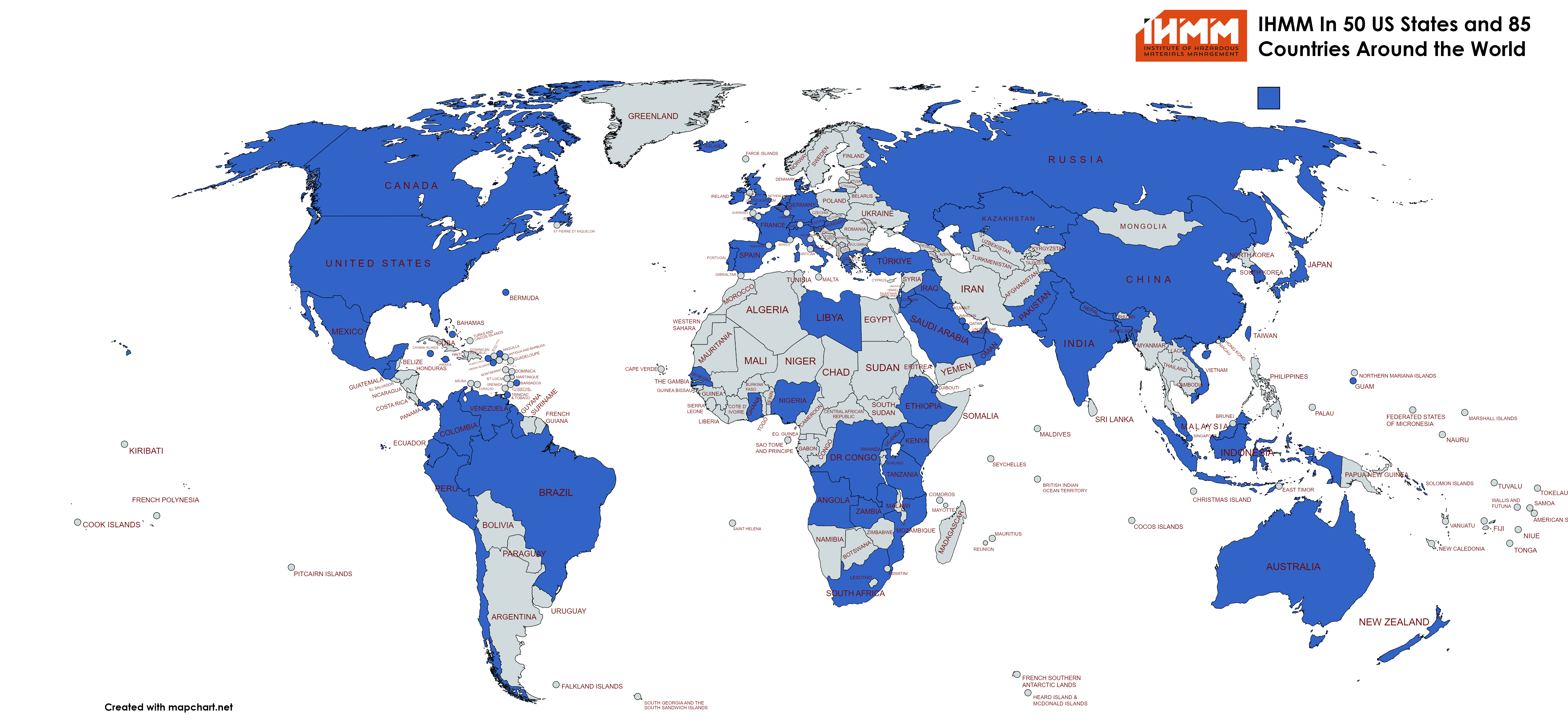
This momentum is more than just numbers; it’s a testament to our unwavering mission. Every day, across 50 states and 85 countries, IHMM champions the critical role of its credentialed professionals, setting standards of excellence in environmental, health, and safety fields. Together, we are shaping the future—one message, one connection, one breakthrough at a time!
7,652,738
IHMM Salary Survey Results
IHMM is pleased to release the survey of salaries underlying the hazardous materials/dangerous goods credentials salaries by job title, as well as the survey of salaries underlying the workplace safety credentials salaries by job title. You may download these surveys as linked below.

IHMM launched its “Open to Work” online COLLABORATION community exclusively for IHMM certificants looking to connect, share resumes, and discover job opportunities together in a supportive environment.
You can find this community after logging into COLLABORATION here: https://community.ihmm.org/home
Sean Grady, CHMM – Environmental Transformation Podcast

Sponsored Content
#1 – Recertification Video
#2 Recertification Video
IHMM Recertification Videos
Congratulations. After hard work and dedication, you earned your professional credential. Now, every 5 years, you will need to recertify your valuable credential. Over 5 years, you need to earn 200 certification maintenance points or CMPs. You receive 100 CMPs for the job you perform, and then need to earn a minimum of another 100 CMPs in a variety of ways, demonstrating your commitment to continuous improvement and remaining current with the demands of your profession and our communities of practice.
Considering everything you did to achieve certification, don’t let it go to waste by failing to recertify.
Upholding Integrity: The Updated IHMM Code of Ethics
At IHMM, integrity isn’t just a principle—it’s the foundation of everything we do. Our Code of Ethics is the guiding standard for all IHMM Certificants, ensuring that professionals in hazardous materials, dangerous goods, environment, health, and safety uphold the highest levels of honor, trust, and responsibility in their work.
By committing to this Code, Certificants reinforce their dedication to excellence, ethical conduct, and public safety. Violating these standards isn’t an option—those who do may face disciplinary action from a peer review panel, including credential suspension or revocation.
We’ve recently updated our Code of Ethics to reflect evolving industry standards and best practices. Stay informed, stay accountable, and continue leading with integrity.
📜 Explore the updated IHMM Code of Ethics here: IHMM Code of Ethics
🎥 Watch the latest Code of Ethics video below!
IHMM Mentors Support

Welcome to the Future of Professional Growth with IHMM’s Mentoring Program!
Are you ready to take your career to the next level? Dive into a world of opportunity and advancement with IHMM’s dynamic mentoring program! Our experienced mentors are here to share their expertise, offer personalized guidance, and help you navigate both credential exams and everyday work challenges.
✨ Unlock Your Potential: Learn from industry leaders and accelerate your professional journey. ✨ Tailored Support: Receive personalized advice and strategies to overcome your unique challenges. ✨ Build Connections: Join a vibrant community of professionals eager to support and inspire each other.
Whether you’re a newcomer in the field or seeking to hone your skills, IHMM’s mentoring program is your gateway to growth and success. Stay tuned for inspiring stories, valuable tips, and exclusive insights from our mentors!
Embark on a journey of discovery and achievement with us. Welcome aboard!
IHMM’s Collaboration platform contains a “Mentor Match” module [see below at right] that allows mentors to signup designating the hours, number of mentees, subject areas, and length of time they wish to mentor – as well as enabling mentees signup requesting assistance in specified areas. The mentor match module does the rest by matching mentors and mentees.
IHMM Government Affairs
Regulatory Updates
IHMM Issues Memorandum – EPA – Updated Definition of Waters of the United States
On November 17, 2025, the U.S. Environmental Protection Agency and the Department of the Army (“the agencies”) announced the signing of a proposed rule to revise the definition of “waters of the United States.” This proposal implements the Supreme Court’s decision in Sackett v. EPA. The proposed rule will play a key role in EPA’s Powering the Great American Comeback initiative by protecting water resources, strengthening cooperative federalism, and supporting American industry, energy producers, the technology sector, farmers, ranchers, developers, businesses, and landowners.
In developing the proposed rule, EPA and the Army reviewed and considered the extensive feedback and recommendations the agencies received from States, Tribes, local governments, and stakeholders throughout consultations and the pre-proposal recommendations docket and listening sessions.
PFAS Reporting Rule Update for CHMMs & CHMPs
Deadline for Comment: December 15, 2025
Risk Matrix for CHMM/CMHP and the Proposed Rule
EPA has proposed significant amendments to its PFAS Reporting and Recordkeeping Rule under TSCA § 8(a)(7). The revisions introduce new exemptions—including a 0.1% de minimis threshold, PFAS in imported articles, non-commercial byproducts and impurities, non-isolated intermediates, and PFAS used solely for R&D. These changes are designed to reduce regulatory burden while preserving critical PFAS reporting requirements for 2011–2022.
For IHMM certificants, the rule remains directly relevant. CHMMs and CHMPs are often responsible for identifying PFAS in materials, auditing historical data, classifying wastes, documenting releases, and ensuring TSCA-compliant reporting. EPA continues to require “known or reasonably ascertainable” information, meaning organizations must search existing records—including SDSs, waste manifests, analytical reports, and supply-chain documentation—to determine whether PFAS were manufactured, used, disposed of, or released. See the Risk Matrix above.
The proposal reinforces core CHMM and CHMP competencies across hazardous materials identification, recordkeeping, waste management, and environmental assessment. IHMM certificants remain essential to organizational compliance and risk reduction as PFAS regulations continue to evolve.
IHMM is preparing comments to submit in response to this proposed rulemaking, and we will provide updates, tools, and training to support our certificants’ leadership in PFAS management.
IHMM – Workplace EHS Coalition Supports OSHA/NIOSH Funding
IHMM, and the Workplace EHS Coalition of which IHMM is a part, is writing to Congressional appropriators in support of funding OSHA and NIOSH, following up on our call for funding those organizations first made last May. With the shutdown over and Congress now back, we have prepared a letter to key House and Senate appropriations subcommittee leaders supporting robust funding levels for OSHA and NIOSH in any full-year FY2026 spending deal.
Fall 2025 Letter to Congress OSHA/NIOSH
The Workplace EHS Coalition (formerly known as the Intersociety Forum) is a coalition of organizations, including ASSP, dedicated to safeguarding worker safety and health and promoting the fact that safety practices create a strategic advantage that powers enduring business success while fostering innovation and protecting workers.
Despite advancements, workplace injury and fatality rates remain stagnant. By adopting proactive, risk-based safety strategies, businesses can unlock greater productivity, reduce costs, and strengthen their global competitiveness. The Workplace EHS Coalition urges today’s business leaders and policymakers to prioritize occupational EHS as a foundation of economic competitiveness. Adopting this approach will position the U.S. as a global leader in safety, innovation and workforce well-being, enabling workers and businesses to thrive.
Important Stories for IHMM Certificants
Environmental News for This Week
During this week, the EPA and the U.S. Army Corps of Engineers proposed a sweeping revision to the definition of “Waters of the United States” (WOTUS), substantially narrowing federal jurisdiction under the Clean Water Act (CWA). Under the proposed rule, only relatively permanent, continuously flowing surface waters — plus wetlands with a direct continuous surface connection — would retain federal protection; ephemeral streams, many wetlands, ditches, and groundwater would be excluded.
Simultaneously, the EPA issued a final action extending compliance deadlines for certain oil and gas emissions-control requirements under the 2024 New Source Performance Standards (NSPS) and related methane-emissions regulations. The extension delays various monitoring, control, and reporting obligations for new and modified sources.
Legal & Regulatory Implications:
Entities operating near or modifying waterways — including renewable energy, land development, or hazardous materials clients — must reassess permitting exposure, wetlands-mitigation obligations, and liability under state laws, as federal oversight retreats.
For companies in oil and gas, and environmental professionals advising them, the compliance delay may provide short-term regulatory relief, but also heightens risk of future enforcement uncertainty — especially if regulators or states later tighten rules.
The combined effect of these developments signals a pivot in federal environmental oversight toward narrower protections, increased reliance on state regulation, and delayed enforcement burden for certain industries.
Workplace Safety News This Week
This week — the week of December 1, 2025 — the most significant workplace-safety issue in the United States remains the persistent failure to implement adequate fall protection. The Occupational Safety and Health Administration (OSHA) released its preliminary 2025 data showing that violations of its “Fall Protection – General Requirements” standard (29 CFR 1926.501) again top the list nationwide, with 5,914 citations — marking the 15th straight year this hazard leads.
The prevalence of fall-related citations — and the additional top-10 entries for fall-protection training, ladders, scaffolding, and other elevation-related hazards — underscores a systemic failure: too many employers continue to expose workers to preventable fall risks, across construction, maintenance, warehousing, and other sectors.
From a legal and compliance perspective, this persistent non-compliance exposes employers to significant risk: regulatory penalties, potential civil liability for injuries or fatalities, increased insurance costs, and reputational harm. Moreover, recurring violations suggest a lack of effective safety culture, training, and hazard remediation — conditions that could support claims of gross negligence if an incident occurs.
In short: despite decades of regulation and repeated enforcement efforts, fall hazards — especially failures to provide guardrails, harnesses, nets, or safe scaffolding/ladder use — remain the single largest workplace safety crisis in the U.S. this week.
Global DG Transport Regulatory Update
IHMM Global DG Transport Compliance Matrix (2025–2026)
IHMM Certificant Compliance Checklist
§1. United States — PHMSA / International Alignment & Enforcement Watch
While there have been no newly published final regulations this week amending 49 C.F.R. Parts 171-180, industry stakeholders should take note of continuing international momentum: the global DG transport regime remains dynamic, especially in modal-intersections such as air and sea, which ultimately affect U.S. exports and imports.
For air freight, the IATA 2025 Dangerous Goods Regulations (DGR), adopted globally earlier this year, remain operative and represent current best-practice standards for shippers using U.S. gateways.
U.S.-based exporters and freight forwarders should ensure that U.S. Haz-Mat documentation, packaging and shipping practices—particularly for lithium or sodium-ion batteries and battery-powered equipment—are consistent with IATA DGR (air), IMDG Code (sea), and the UN Model Regulations foundations that underlie ADR, even if the HMR does not explicitly mirror all of those provisions.
Legal import: Although no new HMR rule is active, failure to voluntarily align with global standards may expose U.S. exporters to increased risk of rejection, liability, or loss of insurance coverage when consignments transit non-U.S. jurisdictions under ADR/UN-based frameworks.
§2. Europe — ADR 2025 in Force; 2027 Cycle Looms
The 2025 edition of ADR, as consolidated in ADR 2025 (ECE/TRANS/352), remains the controlling technical instrument for road-based DG transport in ADR Contracting Parties. Its amendments (including new UN entries, packaging, waste/asbestos provisions, battery/vehicle-battery rules) are now fully operative.
According to recent commentary from the International Road Transport Union (IRU), the next ADR revision cycle (targeting 2027) is already on the horizon. Discussion topics will include carriage by battery-electric vehicles, reverse-logistics (repacked or returned DG), and treatment of undeclared DG in supply-chains.
For EU-based operations, this period marks a transition from “adoption phase” to full compliance and enforcement phase. Operators and compliance managers should audit vehicle approvals, driver training records, DG documentation, packaging, and labels to ensure conformity.
Legal import: As of December 1, ADR 2025 is the operative standard. Parties should treat unamended or outdated documentation, vehicle configurations, or packaging as non-compliant risk. Further, the 2027 revision cycle is effectively “live,” so contractual terms and internal SOPs should include revision-control language to anticipate future amendments.
§3. Asia & Global Modal Overlap — UN / IATA / IMDG as De Facto Benchmark
No major new ADR-type road-transport law emerged this week in Asia. However, given the transmodal nature of modern supply chains, the applicability of the UN Model Regulations (via air or sea), and 2025 IATA updates, remains critical.
Stakeholders shipping lithium / sodium-ion batteries, battery-powered vehicles, or sensitive DG cargo should apply the current IATA DGR and IMDG Code protocols; these draw on the same UN Model Regulations that underlie ADR, ensuring global uniformity.
For Asian carriers or shippers operating road legs under local law, it is prudent to align internal procedures with the “global standard” (UN/ADR) even before domestic adoption. This serves both risk mitigation and future-proofing.
Legal import: For DG consignments crossing multiple borders and transport modes, compliance can no longer be judged by domestic law alone: global UN-based standards (IATA, IMDG, ADR when applicable) now set de facto expectations. Legal counsel should treat these as default standard-of-care benchmarks when drafting contracts and indemnities.
§4. Africa — Status Quo, but Global Trends Filter In
No new pan-African ADR or UN-derived DG regulation was publicly promulgated this week. Many African states continue to rely on a patchwork of national hazardous-substances and transport laws.
Nonetheless, African exporters/importers linked to global supply chains should monitor upcoming ADR 2027 deliberations, as well as IATA/IMDG developments, because these affect cross-border road, sea, and air carriage—sectors increasing in importance across Africa.
Legal import: Absence of new law does not equal absence of risk. Parties operating in or through Africa should embed global DG standards (UN-based classification/packaging/labeling/documentation) in contracts and SOPs to ensure international acceptability, especially for export consignments.
§5. Central & South America — MERCOSUR and Regional DG Regime Snapshot
The regional framework MERCOSUR Agreement on the Land Transport of Dangerous Goods remains the primary DG instrument for over-the-road transport among many South American states. MERCOSUR’s DG agreement is structurally analogous to ADR: it uses the same UN hazard classes, UN numbering, packaging, marking and documentation conventions. UNECE’s regional-analysis documentation lists MERCOSUR as the applicable DG regime for intra-block transport.
As of 2025, ADR 2025 and the updated UN Model Regulations are the global reference points. Although MERCOSUR does not automatically adopt all ADR amendments contemporaneously, its reliance on UN-based classification and its general structural alignment mean many ADR-class consignments remain technically compatible under MERCOSUR-based regulation.
For shipments between South American states—or international shipments transiting MERCOSUR territory—shippers, forwarders, and legal counsel should carefully verify that packaging, documentation, and labeling align with both UN model requirements and any MERCOSUR-region national implementations (since local transposition can vary).
Legal import: For carriers or consignors operating or contracting across South America and outside Europe, ADR should be regarded as a technical benchmark rather than a binding obligation. Contracts should reference compliance with the current UN Model Regulations (by revision number) and mandate that all transport documentation and packaging meet those standards, to maximize international acceptance and minimize liability risk.
§6. Overarching Observations
Global standard of care evolving — not just national law. As of December 1, 2025, the DG transport regime globally is increasingly unified around the 2025 IATA/UN/ADR standards — especially for new technology goods (e.g., sodium-ion batteries, battery-powered vehicles) and waste/asbestos carriage. Entities must evaluate compliance not only against domestic law but against global norms.
Contract drafting must reflect dynamic revision cycles. With ADR in force (2025 version) and 2027 amendment cycle already underway, supply-chain contracts should tie DG compliance to document edition (by UN revision number or ADR volume) and include audit & change-control clauses.
Insurance exposure, liability and enforceability depend on global/regional-level compliance. For multi-modal or multi-jurisdiction consignments (e.g., a U.S.-origin lithium battery shipment to Europe via sea + road), compliance with the UN/IATA/IMDG/ADR stack is critical. Lack of alignment can jeopardize insurer coverage or result in enforcement sanctions.
Training, documentation and packaging are now the compliance battleground. In 2025-2026, regulators and carriers alike are focusing on whether packaging conforms to updated UN codes, vehicles meet ADR/UN design standards, and documentation (DG declarations, special provisions, UN numbers, emergency info) is complete and current.

Anonymous Reporting Systems
In this excerpt from our podcast series, Understanding Firearm-Related Injury and School Violence, Dr. Libby Messman explains key policies and research findings in violence prevention:
We need to understand what aspects of anonymous reporting systems are effective and what schools need in order to support students’ and teachers’ usage of these systems. Learn more here.
______
School Safety Communications Planning Guide
As a school safety leader, you may be faced with widespread misinformation and polarized public opinions. These often leave your local school boards, administrators, teachers, and parents with mixed messages that make it difficult to discern the truth. According to a 2018 MIT Sloan study, false information is 70% more likely to be retweeted than the truth, causing it to reach more people faster than the truth.
You can help prevent incorrect information sharing and create a positive school climate by initiating preemptive conversations about misinformation and disinformation. Students and families are vulnerable to these types of incorrect information, so it is important to discuss these issues in your school and the community.
One way to be prepared to respond appropriately to incorrect information is to create a crisis response communications plan. You can use preplanned and scripted messages to prevent or stop the spread of inaccuracies on social media platforms. Learn More
_______
External Opportunities
12/17 – Preventing Mass Attacks in Our Communities
Hosted by the U.S. Secret Service
1/21/26 – Enhancing School Safety Using Behavioral Threat Assessment
Hosted by the U.S. Secret Service
2/18/26 – Preventing Mass Attacks in Our Communities
Hosted by the U.S. Secret Service
3/18/26 – Enhancing School Safety Using Behavioral Threat Assessment
Hosted by the U.S. Secret Service
4/15/26 – Preventing Mass Attacks in Our Communities
Hosted by the U.S. Secret Service
5/20/26 – Enhancing School Safety Using Behavioral Threat Assessment
Hosted by the U.S. Secret Service

Recent News from the European Chemicals Agency


News from IHMM Affiliates
Alliance of Hazardous Materials Professionals
IHMM is affiliated with AHMP and is pleased to bring this important information to all of our certificants.
AHMP News
- 2026 EHS HAZMAT Summit, September 29 – October 1 in New Orleans, Louisiana.
- Who would you like to see as the keynote speaker? We’re looking for thought leaders and changemakers who can energize our community. Send your speaker suggestions to [email protected]
- Exhibit booths and sponsorship opportunities are open: Learn more
- Call for Abstracts is open! Join us as a presenter in 2026
AHMP Webinars
- Join us on December 22 at 3:30 pm Eastern for a Webinar: Continuing Education – Obtaining, Tracking, Credits vs Units, and More!Do you have letters behind your name? Do you have to take continuing education throughout the year to keep up with the points to keep those letters? This webinar, presented by Glorianna L. Reeser, REM, CSRP, CHMM, CSP, will discuss all the things you need to know to do this! Learn More & Register
American Industrial Hygiene Association
IHMM is affiliated with AIHA and is pleased to bring this important information to all of our certificants.
The Synergist
A Preview of PDCs at AIHA Connect 2026
By Abby Roberts
Although not part of the main three-day conference, professional development courses (PDCs) are important supplements to AIHA Connect programming. These half-day, full-day, and two-day workshops held before and after the conference allow participants to increase their knowledge and technical competencies through learning opportunities that are more intensive, specialized, and hands-on than those supported by conference educational sessions

National Safety Council
IHMM is a member of the National Safety Council and is pleased to bring this important information to all of our certificants.
NSC News
- New video: Firefighter safety at roadway incidents
- OSHA’s Top 10
- NTSB shines light on dangers of unsecured railroad equipment
- EPA further delays provisions of trichloroethylene ban
- Association launches survey on ‘PPE pain points’
- Proposed rule would bolster protections for young workers in Colorado
NSC Webinars
American Society of Safety Professionals
IHMM is a member of the American Society of Safety Professionals and is pleased to bring this important information to all of our certificants.
ASSP News
- The Impact of Giving Back
- Episode 175: Using Predictive Analytics to Help Prevent Incidents in Your Workplace
- After the Shutdown: How Safety Professionals Can Keep Momentum Strong
- Misses and Misunderstandings
- The Power of Gratitude
- Episode 173: How to Effectively Manage the Chemical Inventory at Your Workplace
ASSP Webinars
- Dec 3 – From Safety Data to Strategic Insights: Transforming EHS Analytics with AI
- Jan 29 – Stand-Up for Standards: Ask the Chairs – Z16.1 Key Metrics That Drive Impact
- Feb 13 – Stand-Up for Standards: Understanding the Revised ANSI Z490.1 Training Standard
- Feb 19 – Integrating Z10 to Manage Occupational Health & Safety
- Feb 19 – Accident Investigation Techniques
- Feb 26 – Safety Management II
- Feb 26 – Enterprise Risk Management for Safety Professionals
- Feb 26 – ANSI/ASSP Z16: Using Safety Metrics to Drive Operational Excellence
- Feb 26 – Influential Leadership Skills
- Feb 26 – Risk Assessment and Management for Safety Professionals
- Feb 26 – Integrating ISO 45001 to Manage Occupational Health & Safety
- Feb 26 – Safety Management I
- Feb 26 – Corporate Safety Management
Coming Soon…
The Certified Professional
From the IHMM Foundation | Highlighting Our Commitment to Professional Development | Scholarships | Research | Affinity Programs | Networking |
IHMM and The IHMM Foundation
Check it out! The graphic to the left brings to life the powerful partnership between IHMM and the IHMM Foundation — a collaboration built to support YOU and every IHMM credential holder!
IHMM created the IHMM Foundation with one goal in mind: to empower and elevate its certificants. While IHMM delivers a wide range of prestigious professional credentials, the IHMM Foundation steps in with game-changing professional development programs designed to support both current certificants and those on the path to certification.
Together, they’re building a stronger, smarter, and more connected community of professionals. 🚀 Ready to take your career to the next level? This is where it all begins!


9210 Corporate Boulevard, Suite 470
Rockville, Maryland, 20850
www.ihmm.org | [email protected]
Phone: 301-984-8969 | Fax: 301-984-1516