
Home | IHMM Credentials | Certificants | About IHMM | Event Calendar | Archive | Advertise with IHMM
IHMM Today is an online publication of the Institute of Hazardous Materials Management® (IHMM®).
Other than content specifically provided by IHMM, articles contained in IHMM Today are compiled from
independent sources and do not necessarily reflect the opinions of IHMM.

Sponsored Content
CONTACT INFO:
9210 Corporate Blvd • Suite 470 • Rockville, Maryland | 20850
Ph: 301-984-8969 • [email protected]
Sponsored Content
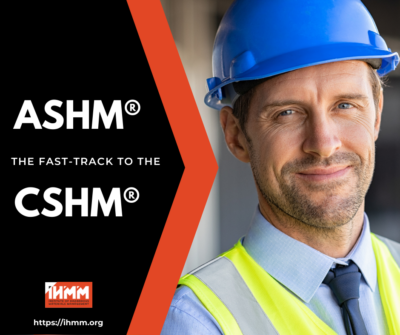
Associate Safety and Health Manager™ (ASHM™)
IHMM’s Associate Safety and Health Manager (ASHM™) credential recognizes professionals who are recent Bachelor’s degree graduates with a focus in health and safety-related fields. This credential puts the holder on the fast-track to the CSHM credential. With ASHM™ on your resume, you tell employers you’re serious about a career in EHS Management.
The Value of IHMM Credentials
Below you will see the credential badges from BadgeCert that are now in each CHMM, CHMP, CDGT, CDGP, AHMM, Student CHMM, CSHM, CSMP, CSSM, ASHM, and Student ASHM certificant’s MYIHMM account. Every IHMM certificant may use these badges, linked as those below are to their IHMM credential page, for their email signatures, business cards, and other social media applications. You’re justifiably proud of the accomplishment of having earned your credential, and you can show the rest of the world.
Sponsored Content
EHS / Workplace Safety Credentials
Certified Safety & Health Manager
Certified Safety Management Practitioner
Associate Safety & Health Manager
Student Associate Safety & Health Manager
Certified School Safety Manager
Hazardous Materials / Dangerous Goods Transportation Credentials
Certified Hazardous Materials Manager
Certified Hazardous Materials Practitioner
Certified Dangerous Goods Professional
Associate Hazardous Materials Manager
Certified Dangerous Goods Trainer
Student Certified Hazardous Materials Manager
Microcredentials – Emeritus – BadgeCert
Certified Pandemic Preparedness Specialist
Emeritus
BadgeCert


IHMM Credentials Accredited By
NEED HELP?

Need Help? On the IHMM website, just click on the “NEED HELP?” button
and let us know what you need, and the right person will get back with you.
IHMM RECENT NEWS

HAZARDOUS MATERIALS/DANGEROUS GOODS
[BLOG] Get Ahead of Key EHS Reports Due in 2026
[CHEAT SHEET] RCRA Biennial Reports Due March 1
[BLOG] Breaking Down the 9 Hazard Classes
California Office of Environmental Health Hazard Assessment (OEHHA), the state agency responsible for implementing Proposition 65 (Prop 65), issued two “Information Letters” regarding Prop 65 compliance issues
Lithium Battery Risks in Aviation explores the growing danger posed by lithium-ion batteries aboard aircraft.
Why Flashpoint Matters in Marine Shipping explains how flashpoint data impacts documentation and stowage rules under the IMDG Code.
EPA Publishes Final Risk Evaluation for 1,3-Butadiene, Intends to Regulate 11 COUs to Protect Workers
2026 Forecast for U.S. Federal and International Chemical Regulatory Policy
Pennsylvania Department of Environmental Protection Releases Final Environmental Justice Policy
Colorado Adopts New State Regulations for Methane Emissions from Landfills
Montana Decision Reaffirms That Federal Environmental Laws Require Specific, Record Based Analyses
CARB Issues Proposed Regulations Implementing SB 253 and SB 26

EHS/WORKPLACE SAFETY
Join us on Jan. 14, 2026, at 12 p.m. CT for Benchmarking Workplace Safety
Chemical Safety Board again without a quorum but pledges more ‘terrific work’
‘Self-certification has to go,’ FMCSA leader says
OSHA launches Safety Champions Program
Lessons learned: Volume 4 of OSHA’s ‘most interesting cases’
A new year of purpose: Elevate leadership, learning and SIF prevention in 2026
NIOSH Respirator Approval Program
2026 DOT Random Testing Rates Notice
Providing Effective Training to Every Generation of the Workforce
ICYMI – Safety 2026 Registration is Now Open!
Study explores how to prevent combustible dust explosions
OSHA makes corrections to Hazard Communication Standard
Arizona task force releases recommendations on protecting workers from heat
Now in effect: revisions to California’s rules on confined spaces in construction
Oregon OSHA Releases New Worker Safety and Rights Guide
Inside IHMM

Whether you are just starting out in your career or are a seasoned professional serving the global environmental, health, and safety communities of practice, IHMM offers resources and professional credentials to help you advance and grow in your career.
Hear from one of IHMM’s Certificant Insiders on why they chose to pursue a credential through IHMM.

Q&A with IHMM Certificant Insider
Keslie Inman, CHMM
Senior Environmental Analyst
Associated Electric Cooperative, Inc.
What or who motivated you to earn an IHMM credential?
I pursued an IHMM credential because it represents a gold standard across industries, and I knew it would open new pathways for my long-term career journey. Over nearly seven years in environmental consulting and industry, I have had the privilege of working alongside talented people, several of whom became my own trusted mentors. Many of them held IHMM certifications, and I got to witness firsthand how their expertise, credibility, and leadership positively impacted their mentees, organizations, and sometimes even the broader industry. Their example set the bar for the kind of professional that I wanted to become. Earning a CHMM certification felt like a natural next step if I hoped to contribute to that level. I wanted to make that commitment to a standard of excellence that I see in my mentors.
Are there any opportunities you’re looking forward to as a result of earning an IHMM credential?
Earning my CHMM has positioned me to take on broader, more strategic responsibilities. While I ultimately aspire to move into leadership, I am really enjoying the opportunity to serve as a subject matter expert in my current role. The breadth of the CHMM certification shows up in my work every day. I hope that as my career evolves, the CHMM certification will open the door to roles where I can influence strategy, guide teams, and help shape our organization’s environmental performance to a higher level.
What would you say to someone who is considering earning an IHMM credential?
I’d tell them it is absolutely worth the investment! The process is challenging, I won’t sugar-coat it, but that’s exactly why the credential holds so much weight. Whether you pursue the CHMM or other IHMM certification, people will notice your drive, your discipline to study, and your willingness to take on complex material. My advice is to pace yourself, stay consistent, and trust the process. The effort pays out in credibility, career mobility, and the confidence that comes from just getting that hard-copy certificate in the mail. Play the long-game, and you’re sure to win!
Become an IHMM Insider by Finding the Perfect IHMM Credential
Free Webinar – ISO 45001 – Evidence for the effectiveness of occupational health and safety management systems: what do we really know?
We are pleased to invite you to a free webinar – hosted jointly by ISO Technical Committee 283 and the Lloyd’s Register Foundation Global Safety Evidence Centre – bringing together leading international researchers and practitioners to examine the latest evidence on the effectiveness of occupational health and safety (OHS) management systems. The webinar takes place on 29 January 2026 at 13:00 UTC for 90 minutes.
- 08:00 (8:00 AM) Eastern Standard Time (EST) / Eastern Daylight Time (EDT) (UTC-5/UTC-4)
- 07:00 (7:00 AM) Central Standard Time (CST) / Central Daylight Time (CDT) (UTC-6/UTC-5)
- 06:00 (6:00 AM) Mountain Standard Time (MST) / Mountain Daylight Time (MDT) (UTC-7/UTC-6)
- 05:00 (5:00 AM) Pacific Standard Time (PST) / Pacific Daylight Time (PDT) (UTC-8/UTC-7)
With a particular focus on ISO 45001, this event will present findings from major studies, including:
- Do safety management system standards indicate safer operations? Evidence from the OHSAS 18001 occupational health and safety standard (Harvard University and Duke University, USA)
- Differences in occupational health and safety efforts between adopters and non-adopters of certified occupational health and safety management systems (funded by the Danish Work Environment Research Fund, Denmark)
- The effectiveness of accredited certifications for occupational health and safety management systems (Accredia and INAIL, Italy)
Building on existing work from the Global Safety Evidence Centre on the effectiveness of OHS interventions and leading indicators, the discussion will explore whether implementation of an OHS management system based on a recognised standard leads to measurable improvements in workplace safety and health. We will also look at the factors that support effective implementation and consider how research evidence can inform the ongoing development of the ISO 45000 series.
By the end of the webinar, participants will:
- Understand the latest evidence on the effectiveness of OHS management systems, particularly ISO 45001.
- Gain insight into key mechanisms and organisational factors that influence outcomes.
- Consider how evidence can be integrated into standards development.
- Reflect on implications for future revisions within the ISO 45000 series.
This event will be of interest to anyone involved in improving OHS, including practitioners, ISO committee members, auditors and certification professionals, organisational management and leadership, compliance and risk teams, researchers, educators and training providers.
To register, please visit the event page.

This symbol reflects
the company strongly
supports IHMM certificants
Professional Development
Support the Future of EHS
The IHMM Foundation Jobs Board
We invite our participating companies to post their available employment opportunities here. There is no charge for this service. IHMM Foundation/HMS staff reviews each proposed posting for clarity and completeness before posting to the public view and may remove a posting without notice. Go here to post your available jobs.

Research and Resources For You
The IHMM Foundation/HMS is committed to the continued growth of IHMM’s certificants and to supporting them in every way we can. We achieve this through work that aims to gain insights that align with our mission to educate, develop, inform, and unite the hazardous materials, dangerous goods, and environmental health and safety communities of practice.
IHMM’s certificants will find important resources that most of our certificants use. If you don’t find what you need, use the button below to let us know and we will get it and post it here for you.
If you are you looking for additional resources not listed on this page? We can help!
IHMM Research is found at https://hazmatsociety.org/research/
Added this week >
IHMM’s Unprecedented Outreach: Elevating Excellence Worldwide
2025 marks another milestone moment for IHMM! IHMM has sent 8.9 million messages to thousands of private and public sector entities, amplifying awareness of IHMM, our prestigious credentials, and the dedicated professionals who hold them.
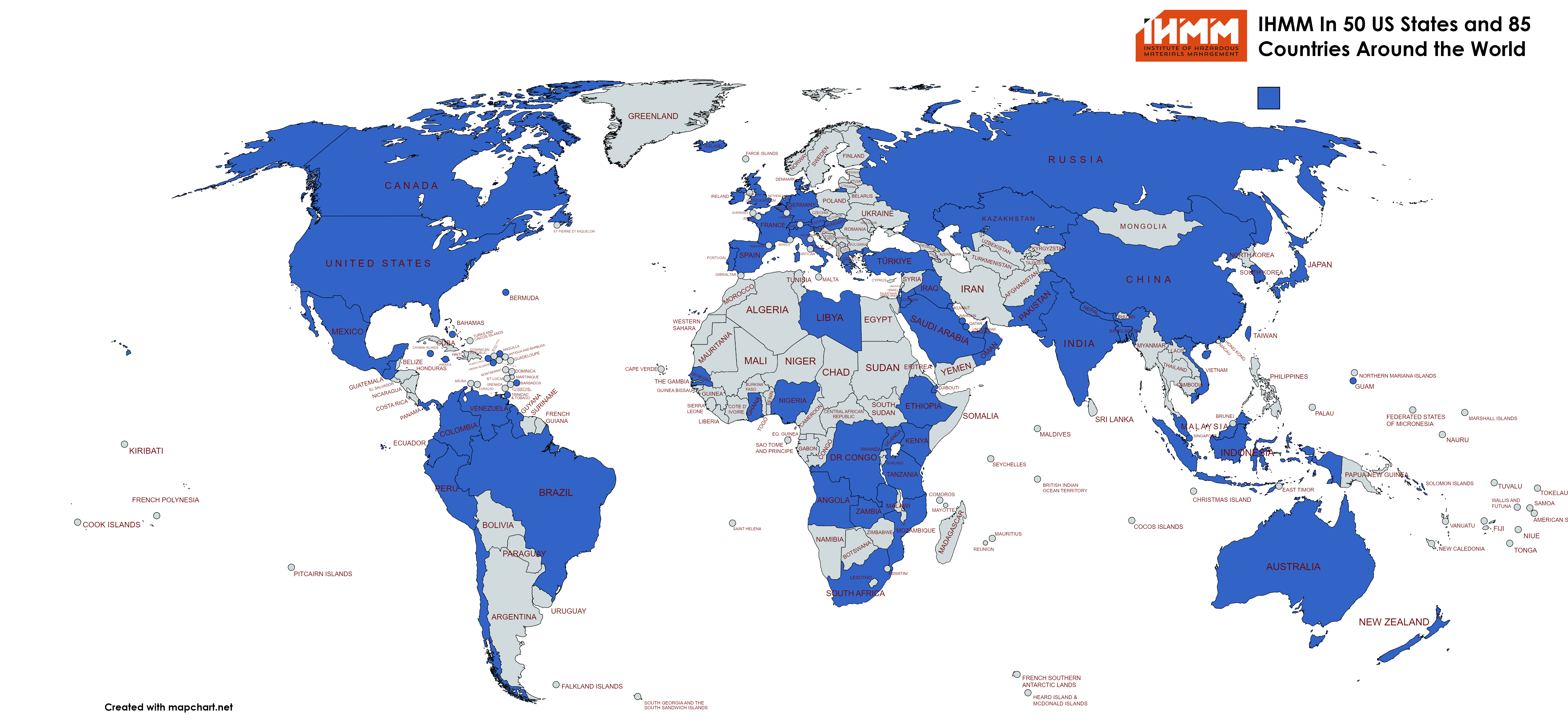
This momentum is more than just numbers; it’s a testament to our unwavering mission. Every day, across 50 states and 85 countries, IHMM champions the critical role of its credentialed professionals, setting standards of excellence in environmental, health, and safety fields. Together, we are shaping the future—one message, one connection, one breakthrough at a time!
8,963,657
IHMM Salary Survey Results
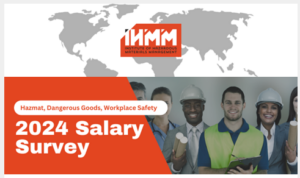
IHMM is pleased to release the survey of salaries underlying the hazardous materials/dangerous goods credentials salaries by job title, as well as the survey of salaries underlying the workplace safety credentials salaries by job title. You may download these surveys as linked below.

IHMM launched its “Open to Work” online COLLABORATION community exclusively for IHMM certificants looking to connect, share resumes, and discover job opportunities together in a supportive environment.
You can find this community after logging into COLLABORATION here: https://community.ihmm.org/home
Sean Grady, CHMM – Environmental Transformation Podcast

Sponsored Content
#1 – Recertification Video
#2 Recertification Video
IHMM Recertification Videos
Congratulations. After hard work and dedication, you earned your professional credential. Now, every 5 years, you will need to recertify your valuable credential. Over 5 years, you need to earn 200 certification maintenance points or CMPs. You receive 100 CMPs for the job you perform, and then need to earn a minimum of another 100 CMPs in a variety of ways, demonstrating your commitment to continuous improvement and remaining current with the demands of your profession and our communities of practice.
Considering everything you did to achieve certification, don’t let it go to waste by failing to recertify.
Upholding Integrity: The Updated IHMM Code of Ethics
At IHMM, integrity isn’t just a principle—it’s the foundation of everything we do. Our Code of Ethics is the guiding standard for all IHMM Certificants, ensuring that professionals in hazardous materials, dangerous goods, environment, health, and safety uphold the highest levels of honor, trust, and responsibility in their work.
By committing to this Code, Certificants reinforce their dedication to excellence, ethical conduct, and public safety. Violating these standards isn’t an option—those who do may face disciplinary action from a peer review panel, including credential suspension or revocation.
We’ve recently updated our Code of Ethics to reflect evolving industry standards and best practices. Stay informed, stay accountable, and continue leading with integrity.
📜 Explore the updated IHMM Code of Ethics here: IHMM Code of Ethics
🎥 Watch the latest Code of Ethics video below!
IHMM Mentors Support

Welcome to the Future of Professional Growth with IHMM’s Mentoring Program!
Are you ready to take your career to the next level? Dive into a world of opportunity and advancement with IHMM’s dynamic mentoring program! Our experienced mentors are here to share their expertise, offer personalized guidance, and help you navigate both credential exams and everyday work challenges.
✨ Unlock Your Potential: Learn from industry leaders and accelerate your professional journey. ✨ Tailored Support: Receive personalized advice and strategies to overcome your unique challenges. ✨ Build Connections: Join a vibrant community of professionals eager to support and inspire each other.
Whether you’re a newcomer in the field or seeking to hone your skills, IHMM’s mentoring program is your gateway to growth and success. Stay tuned for inspiring stories, valuable tips, and exclusive insights from our mentors!
Embark on a journey of discovery and achievement with us. Welcome aboard!
IHMM’s Collaboration platform contains a “Mentor Match” module [see below at right] that allows mentors to signup designating the hours, number of mentees, subject areas, and length of time they wish to mentor – as well as enabling mentees signup requesting assistance in specified areas. The mentor match module does the rest by matching mentors and mentees.
IHMM Government Affairs

Stormwater Centers of Excellence
January 28, 2026
1:30 p.m. – 3:00 p.m. Eastern Time
Stormwater is a significant source of water pollution, threatening the health of waterways nationwide. However, financial and engineering challenges make stormwater difficult for communities to manage. Recognizing this challenge, EPA awarded $5M in grant funding to establish the new Centers of Excellence for Stormwater Control Infrastructure Technologies Grant Program.
Join us to meet the recently established Centers and learn about their research, training, and technical assistance offerings. Plus, explore the National Stormwater Managers’ Clearinghouse designed to share new and emerging stormwater control infrastructure technologies and the Centers’ activities and projects.
Topics
- Cold Climate Center of Excellence for Stormwater Infrastructure Technology (CCCESIT)
- Great Plains Stormwater Center of Excellence
- Southwest Stormwater Center of Excellence
- Coastal Stormwater Center of the Southeast
- National Stormwater Managers’ Clearinghouse
Registration Link:
https://usepa.zoomgov.com/meeting/register/6KfUAb97QzCwnoDvk3U1Ag
For any questions related to this announcement, please contact [email protected].
Two Regulatory Actions Under Review
PHMSA – ANPRM HM-266 – Highly Automated Transport Systems – CHMMs and CDGPs
Synopsis of ANPRM — PHMSA: Modernizing Hazardous Materials Regulations for Highly Automated Transportation Systems
Deadline: March 4, 2025
Purpose:
PHMSA seeks comments to inform a future Notice of Proposed Rulemaking (NPRM) concerning how the existing HMR should be modernized to safely and effectively accommodate the emerging use of highly automated transportation systems (HATS) in the movement of hazardous materials. This includes evaluating whether current regulatory provisions, developed with traditional human-operated conveyances in mind, pose safety ambiguities or operational impediments in automated contexts. Federal Register Public Inspection
National Primary Drinking Water Regulation for Perchlorate
Deadline: March 9, 2026
The U.S. Environmental Protection Agency (“EPA” or the “Agency”) is proposing a National Primary Drinking Water Regulation (NPDWR) for perchlorate and a health-based Maximum Contaminant Level Goal (MCLG) under the Safe Drinking Water Act (SDWA). In this action, the EPA is proposing to set the perchlorate MCL at 0.02 mg/L (20 µg/L). The EPA is also proposing and taking comment on setting an enforceable Maximum Contaminant Level (MCL) for perchlorate at 0.02 mg/L (20 µg/L), 0.04 mg/L (40 µg/L), or 0.08 mg/L (80 µg/L). The EPA is also proposing requirements for water systems to conduct monitoring for perchlorate in drinking water, take mitigation actions if the level exceeds the MCL, provide information about perchlorate to their consumers through public notification and consumer confidence reports, and report to their respective primacy agency. The Administrator has determined that the benefits of this regulation would not justify the costs; however, the EPA is required to issue an NPDWR and MCLG for perchlorate in response to the D.C. Circuit’s decision in NRDC v. Regan.
Important Stories for IHMM Certificants
Environmental News for This Week
During the week of January 11, 2026, U.S. environmental policy was marked by heightened regulatory volatility and litigation risk, as the federal government advanced measures to narrow procedural and substantive environmental safeguards.
First, the White House finalized changes to the National Environmental Policy Act (NEPA) framework, aimed at accelerating permitting timelines by reducing review burdens and limiting judicial and public-process exposure. The revisions have triggered immediate concern from environmental groups and are expected to generate administrative-law challenges alleging weakened environmental accountability and diminished public participation.
Second, the Environmental Protection Agency undertook several consequential regulatory actions. EPA announced it will reassess the safety of the herbicide paraquat, a move with significant implications for pesticide registrants, agricultural operators, and toxic-tort litigation trends. EPA also advanced a broader deregulatory strategy, reportedly initiating efforts to roll back numerous rules across air, water, and climate programs—creating significant uncertainty for compliance planning and enforcement posture.
Finally, EPA’s proposed WOTUS rule remained central as stakeholders digested the closing of the comment period earlier in January, foreshadowing major jurisdictional shifts under the Clean Water Act and heightened state-level permitting fragmentation.
Biennial Hazardous Waste Report – March 1
Federal regulations require large quantity generators to submit a report every two years regarding the nature, quantities and disposition of hazardous waste generated at their facility. EPA refers to this as the National Biennial RCRA Hazardous Waste Report or Biennial Report.
The Biennial Report form (EPA form 8700-13A/B) must be submitted to the authorized state agency or EPA regional office by March 1 of every even-numbered year (for example, a report due by March 1, 2026, would report activities from calendar year 2025). The form includes information such as:
- Facility’s EPA ID Number.
- Facility’s name and address.
- Quantity and nature of hazardous waste generated.
- Whether the hazardous waste was sent for recycling, treatment, storage, or disposal.
Workplace Safety News This Week
U.S. Department of Labor issues 7 letters of interpretation addressing workplace safety, health requirements
The U.S. Department of Labor’s Occupational Safety and Health Administration announced on December 10th that it has issued seven letters of interpretation to ensure the consistent and transparent application of federal workplace safety and health standards.
As part of the Trump Administration’s broader emphasis on compliance assistance, OSHA’s letters of interpretation provide official explanations of the agency’s requirements and how they apply to specific workplace situations and hazardous conditions posed by employers, employees, or other parties.
US Department of Labor issues 6 opinion letters addressing employee classification, bonuses, overtime exemptions, family medical leave
The U.S. Department of Labor’s Wage and Hour Division on January 5 issued six opinion letters designed to promote clarity, consistency, and transparency in the application of federal labor standards under the Fair Labor Standards Act and Family and Medical Leave Act.
The opinion letters provide official written interpretations from the division that address real-world questions and explain how laws apply to specific factual circumstances presented by individuals or organizations, that may also have a broader interest to those impacted by the issue presented.
IHMM is a Premier Partner of the Falls 2026 Campaign
May 4-8, 2026
What is a Safety Stand-Down?
A Safety Stand-Down is a voluntary event for employers to talk directly to employees about safety. Any workplace can hold a stand-down by taking a break to focus on “Fall Hazards” and reinforcing the importance of “Fall Prevention”. Employers of companies not exposed to fall hazards can also use this opportunity to have a conversation with employees about the other job hazards they face, protective methods, and the company’s safety policies and goals. It can also be an opportunity for employees to talk to management about falls and other job hazards they see.
In the coming weeks, IHMM will be making materials available for the Falls 2026 Campaign! In addition, IHMM is looking for 2 volunteers, each from a different construction company, who can tell a great story about how they prevent falls in construction.
Global DG Transport Regulatory Update
IHMM Global DG Transport Compliance Matrix (2025–2026)
IHMM Certificant Compliance Checklist
Week of January 11, 2026
I. Executive Overview
The week of January 11, 2026 reflects a post-effective-date consolidation phase in global dangerous-goods regulation. With ADR 2025 firmly in force, IMDG Code Amendment 42-24 now mandatory as of January 1, 2026, and ICAO Technical Instructions / IATA DGR 2026 operational, regulators worldwide are focused on enforcement, interpretation, and harmonization, rather than new headline rulemakings.
Across jurisdictions, regulatory risk this week arises not from new treaty text, but from how existing instruments are being applied, particularly for battery technologies, hazardous waste, undeclared DG, and multimodal shipments.
II. United States — PHMSA Enforcement and International Convergence
A. PHMSA Enforcement Priorities Continue to Drive Compliance
During the week of January 11, PHMSA did not issue new amendments to 49 C.F.R. Parts 171–180. However, the agency’s data-driven inspection and enforcement framework, introduced in late 2025, is now fully embedded in field operations.
PHMSA activity during this week continues to emphasize:
Lithium-ion and sodium-ion battery shipments, including battery-powered equipment and vehicles;
Pressure receptacles, including cylinder manufacture, requalification, and testing;
Undeclared or misdeclared hazardous materials, especially in parcel, courier, and e-commerce channels; and
Repeat violators, identified through historical inspection and incident data.
Legal Significance
From a legal perspective, PHMSA’s enforcement posture has materially elevated the effective standard of care for U.S. DG shippers. Although the Hazardous Materials Regulations remain textually unchanged, regulated entities—particularly exporters—are now expected to demonstrate functional equivalence with UN Model Regulations and ADR-aligned practices, especially where shipments move into international supply chains.
Failure to align U.S. documentation, packaging, and training with these global norms increasingly presents enforcement, contractual, and insurance risk.
III. Europe — ADR 2025 as Settled Law; ADR 2027 on the Horizon
A. ADR 2025 Fully Operational
By mid-January 2026, ADR 2025 is fully embedded across all Contracting Parties. During the week of January 11, European authorities continued routine inspections and issued operational clarifications addressing:
Application of new battery-related UN entries, including sodium-ion batteries;
Revised requirements for hazardous waste and asbestos transport;
Vehicle and equipment standards under ADR Part 9, particularly for alternative propulsion systems; and
Recognition and validity of ADR driver training certificates under Chapter 8.2.
These actions underscore that transitional tolerance has effectively ended.
B. Early Development of ADR 2027 Proposals
Concurrently, informal work within the UNECE Working Party on the Transport of Dangerous Goods (WP.15) continues to shape the ADR 2027 amendment cycle, with emerging focus on:
DG carriage by battery-electric and hybrid heavy vehicles;
Regulation of reverse logistics and returned dangerous goods;
Reassessment of limited quantity (LQ) exemptions; and
Enhanced controls for undeclared DG in small-parcel and e-commerce distribution.
Legal Significance
For European and international operators, ADR 2025 is now the unquestioned compliance baseline. Contracts, SOPs, and training programs should already incorporate change-management provisions anticipating additional tightening in ADR 2027, particularly for batteries and consumer-distribution channels.
IV. Asia — Carrier and Port Standards Set the Compliance Floor
A. Limited Domestic Rulemaking
No major national DG transport statutes or regulations were promulgated in key Asian jurisdictions during the week of January 11, 2026.
B. Mandatory Application of Global Instruments
Despite legislative quiet, the compliance environment in Asia has shifted materially because:
IMDG Code Amendment 42-24 is now mandatory worldwide as of January 1, 2026;
ICAO Technical Instructions / IATA Dangerous Goods Regulations 2026 are fully operative for air transport; and
Ocean carriers and ports are enforcing UN-aligned battery and waste requirements without transitional leniency.
Legal Significance
In Asia, carrier and port acceptance criteria now effectively define compliance. From a legal-risk standpoint, UN- and ADR-aligned classification, packaging, labeling, and documentation are no longer optional best practices—they are prerequisites for market access.
V. Africa — Enforcement-Led Convergence with UN and ADR Standards
A. No New DG Legislation Issued
No African jurisdiction enacted a major DG-specific statute or regulation during the week of January 11.
B. Practical Alignment Through Trade and Enforcement
Nonetheless, African ports, customs authorities, and transport operators continue to tighten DG controls by:
Requiring documentation consistent with UN classification and numbering;
Applying IMDG 42-24 standards for maritime shipments; and
Subjecting battery and hazardous-waste consignments to heightened inspection.
Legal Significance
For multinational shippers, Africa illustrates a critical trend: practical enforcement is converging on UN/ADR standards faster than legislation. Compliance failures increasingly manifest as shipment delays, refusals, or commercial disputes rather than formal regulatory citations.
VI. Central & South America — MERCOSUR Stability, National Enforcement Takes Center Stage
A. MERCOSUR Framework Remains the Regional Baseline
At the regional level, no new MERCOSUR DG decisions were adopted during the week of January 11. The controlling instrument remains the MERCOSUR Agreement on the Land Transport of Dangerous Goods, as modernized by CMC Decision 15/2019, which is expressly tied to the UN Model Regulations.
B. National Authorities Intensify Oversight
More consequential are national-level developments observed across the region:
Argentina continues active inspection of battery-powered equipment and vehicles under its UN-aligned implementation regime;
Brazil is applying clarified guidance under ANTT Resolution 5.998/2022 for sodium-ion batteries and updated UN entries; and
Colombia is now fully enforcing its dangerous-goods transport registry, with reporting and traceability obligations firmly in place.
Legal Significance
While MERCOSUR provides technical harmonization, compliance exposure is increasingly national and enforcement-driven. Shippers must verify alignment with each country’s implementing measures, inspection practices, and reporting systems, rather than relying solely on regional consistency.
VII. Overall Assessment
For the week of January 11, 2026, global DG regulation is characterized by:
Enforcement-led evolution without new statutory text (United States, South America);
Full operational consolidation of ADR 2025 (Europe);
Mandatory application of IMDG 42-24 and ICAO/IATA 2026 (Asia and globally); and
Rising reliance on UN/ADR standards as the de facto global benchmark (Africa and emerging markets).
Across all regions, battery technologies, hazardous waste, and undeclared dangerous goods remain the principal regulatory pressure points.
VIII. Conclusion
As of mid-January 2026, dangerous-goods transportation law has entered a phase where compliance risk is driven less by new rules and more by how existing rules are enforced and harmonized internationally.
For IHMM certificants and DG professionals, the prudent course is to treat PHMSA enforcement priorities, ADR 2025, the UN Model Regulations, IMDG Code Amendment 42-24, and ICAO 2026 Technical Instructions as the operative global standard of care. Organizations should review documentation, packaging approvals, training programs, and contractual controls accordingly as the 2026 compliance year begins.

Essential Elements of School Threat Assessment
In this excerpt from the webinar “Essential Elements of School Threat Assessment,” Dr. Dewey Cornell discusses the fundamentals of the process and the importance of using multidisciplinary teams to prevent violence:
So what do [threat assessment] teams do? How do they function? Almost all authorities… recommend a multidisciplinary team. This is very important because it gives you multiple perspectives on the problem, access to information from multiple parties, and resources that those individuals bring to the table. Threat assessment is not a job for the ‘Lone Ranger.’ You do not want to go this alone; you want to have assistance, consultation, and collaboration. Team membership is going to vary depending on the resources and staffing at your school… [and] what state laws or regulations might mandate…
[Threat assessment] team membership is going to vary depending on the resources and staffing at your school… [and] what state laws or regulations might mandate… Should every school have a team, or could you have one team for your district or region? There are some disadvantages to relying on an external team and advantages to having an internal team. If you have a local team at your school, they are going to be able to respond much more quickly. They are knowledgeable of the students, they know the school context, and when it comes to developing interventions… they are on hand to monitor and follow up…
Teams should meet regularly. How often depends on the size of the school or the case load. Certainly, teams are going to meet when they have a new case… but they may have ongoing cases where they want to check in periodically to see how things are going. Are interventions working? Are any new actions needed?
_______
External Opportunities
1/21/26 – Enhancing School Safety Using Behavioral Threat Assessment
Hosted by the U.S. Secret Service
2/18/26 – Preventing Mass Attacks in Our Communities
Hosted by the U.S. Secret Service
3/18/26 – Enhancing School Safety Using Behavioral Threat Assessment
Hosted by the U.S. Secret Service
4/15/26 – Preventing Mass Attacks in Our Communities
Hosted by the U.S. Secret Service
5/20/26 – Enhancing School Safety Using Behavioral Threat Assessment
Hosted by the U.S. Secret Service
Recent News from the European Chemicals Agency
- We take on additional tasks to strengthen chemical safety in Europe
- New substance evaluation conclusion published
- Treated articles: List of allowed substances updated
- List of biocides suppliers updated
- Companies can start notifying intentions under the Drinking Water Directive
- Drinking Water Directive stakeholder workshop: Q&A available
- We take on new responsibilities to improve toy safety
- REACH registration data and C&L Inventory now only available in ECHA CHEM
- Reminder: Survey on nanomaterials used as or integrated into flame retardants
- Biocides decision on Union authorisation


News from IHMM Affiliates
Alliance of Hazardous Materials Professionals
IHMM is affiliated with AHMP and is pleased to bring this important information to all of our certificants.
AHMP News
- Congratulations to the 2026 AHMP Executive Committee:
- Chair – Jennifer Koenig, CHMM
- Vice Chair – Vincent Ricevuto, PE, CHMM, REM, CSP, PMP
- Treasurer – Dave Rice, CHMM
- Secretary – Jan Marnicki, CHMM, LMT
- 2026 EHS HAZMAT Summit, September 29 – October 1 in New Orleans, Louisiana.
- Exhibit booths and sponsorship opportunities are open: Learn more
- Call for Abstracts is open! Join us as a presenter in 2026
AHMP Webinars
- Join us on January 22 at 3:30 pm Eastern for a Webinar: Rechargeable Lithium Ion Batteries– Most rechargeable batteries are safe—but some pose hidden risks. This webinar, presented by Ben Hissam, covers how to identify batteries that may fail, catch fire, or explode; the types of rechargeable batteries on the market; and how thermal runaway occurs. The presentation focuses on e-mobility devices and common home and workplace items, and includes tips for protecting yourself and avoiding hazards from improper disposal. Learn More & Register
American Industrial Hygiene Association
IHMM is affiliated with AIHA and is pleased to bring this important information to all of our certificants.
The Synergist
Top News Stories of 2025
By Abby Roberts
A new year has begun, and Synergist staff are celebrating the start of 2026 with a look back on the news stories that most ignited readers’ interest in the previous year. In the spring of 2025, the news was dominated by the second Trump Administration’s drastic reorganization of the Department of Health and Human Services, followed that summer by “aggressive deregulatory efforts” directed at the Department of Labor. But the federal government was not the focus of all 2025 headlines

National Safety Council
IHMM is a member of the National Safety Council and is pleased to bring this important information to all of our certificants.
NSC News
- OSHA makes corrections to Hazard Communication Standard
- Arizona task force releases recommendations on protecting workers from heat
- New SIF prevention tool helps identify safety gaps
- OSHA launches Safety Champions Program
- Now in effect: NYC’s new construction superintendent rule
- Bill aimed at ending OSHA efforts to finalize proposed heat rule
NSC Webinars
- Jan 13-16 – Safety Training Methods – ASC Virtual 4-Day Course : 01/13/26 – 01/16/26 Session
- Jan 15 – Beyond the Safety Department: Scaling EHS Expertise to Every Frontline Decision
- Jan 15 – Incident Investigation – ASC Virtual One-Day Course : 01/15/26 Session
- Jan 16 – Job Safety Analysis – ASC Virtual One-Day Course : 01/16/26 Session
- Jan 28 – Safety Inspections – ASC Virtual One-Day Course : 01/28/26 Session
- Jan 29 – Team Safety – ASC Virtual One-Day Course : 1/29/26 Session
- Jan 29 – The HazCom Compliance Clock is Ticking! Here’s How to Meet Updated Requirements
- Feb 16-19 – Safety Training Methods – ASC Virtual 4-Day Course : 02/16/26 – 02/19/26 Session
- Feb 23-27 – Fundamentals of Industrial Hygiene – ASC Virtual 5-Day course : 02/23/26 – 02/27/26 Session
- Feb 26 – Safety Inspections – ASC Virtual One-Day Course : 02/26/26
American Society of Safety Professionals
IHMM is a member of the American Society of Safety Professionals and is pleased to bring this important information to all of our certificants.
ASSP News
- Cognitive Fatigue & Task Complexity: Ensuring Worker Safety in Construction & Engineering
- Episode 177: Providing Effective Training to Every Generation of the Workforce
- Why ISO 45001 is the Global Game-Changer for Every Safety Professional
- Episode 176: Working on the Night Shift – What Safety Pros Need to Know
- The Impact of Giving Back
- Episode 175: Using Predictive Analytics to Help Prevent Incidents in Your Workplace
ASSP Webinars
- Jan 29 – Stand-Up for Standards: Ask the Chairs – Z16.1 Key Metrics That Drive Impact
- Feb 13 – Stand-Up for Standards: Understanding the Revised ANSI Z490.1 Training Standard
- Feb 19 – Integrating Z10 to Manage Occupational Health & Safety
- Feb 19 – Accident Investigation Techniques
- Feb 26 – Safety Management II
- Feb 26 – Enterprise Risk Management for Safety Professionals
- Feb 26 – ANSI/ASSP Z16: Using Safety Metrics to Drive Operational Excellence
- Feb 26 – Influential Leadership Skills
- Feb 26 – Risk Assessment and Management for Safety Professionals
- Feb 26 – Integrating ISO 45001 to Manage Occupational Health & Safety
- Feb 26 – Safety Management I
- Feb 26 – Corporate Safety Management
Coming Soon…
The Certified Professional
From the IHMM Foundation | Highlighting Our Commitment to Professional Development | Scholarships | Research | Affinity Programs | Networking |
IHMM and The IHMM Foundation
Check it out! The graphic to the left brings to life the powerful partnership between IHMM and the IHMM Foundation — a collaboration built to support YOU and every IHMM credential holder!
IHMM created the IHMM Foundation with one goal in mind: to empower and elevate its certificants. While IHMM delivers a wide range of prestigious professional credentials, the IHMM Foundation steps in with game-changing professional development programs designed to support both current certificants and those on the path to certification.
Together, they’re building a stronger, smarter, and more connected community of professionals. 🚀 Ready to take your career to the next level? This is where it all begins!


9210 Corporate Boulevard, Suite 470
Rockville, Maryland, 20850
www.ihmm.org | [email protected]
Phone: 301-984-8969 | Fax: 301-984-1516