
Home | IHMM Credentials | Certificants | About IHMM | Event Calendar | Archive | Advertise with IHMM
IHMM Today is an online publication of the Institute of Hazardous Materials Management® (IHMM®).
Other than content specifically provided by IHMM, articles contained in IHMM Today are compiled from
independent sources and do not necessarily reflect the opinions of IHMM.

Sponsored Content
CONTACT INFO:
9210 Corporate Blvd • Suite 470 • Rockville, Maryland | 20850
Ph: 301-984-8969 • [email protected]
Sponsored Content
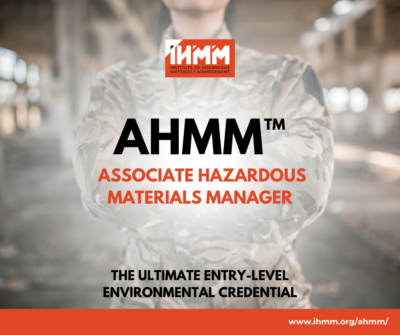
Associate Hazardous Materials Manager™ (AHMM™)
The Associate Hazardous Materials Manager™ (AHMM™) credential launches your career in environmental and safety management. Designed for recent graduates, transitioning military personnel, and early-career professionals — including first responders — the AHMM opens the door to a world of opportunity in hazardous materials handling and environmental protection.
AHMM professionals are the new generation of experts tackling real-world challenges in safety, compliance, and dangerous goods transportation. Whether you’ve gained hands-on experience through military service in a specialized MOS or AFSC, or academic training in chemistry, biology, environmental science, or engineering, the AHMM recognizes your emerging expertise and drive.
Start your journey with AHMM — where knowledge meets action and your career in environmental excellence begins.

Sponsored Content
The Value of IHMM Credentials
Below you will see the credential badges from BadgeCert that are now in each CHMM, CHMP, CDGT, CDGP, AHMM, Student CHMM, CSHM, CSMP, CSSM, ASHM, and Student ASHM certificant’s MYIHMM account. Every IHMM certificant may use these badges, linked as those below are to their IHMM credential page, for their email signatures, business cards, and other social media applications. You’re justifiably proud of the accomplishment of having earned your credential, and you can show the rest of the world.
EHS / Workplace Safety Credentials
Certified Safety & Health Manager
Certified Safety Management Practitioner
Associate Safety & Health Manager
Student Associate Safety & Health Manager
Certified School Safety Manager
Hazardous Materials / Dangerous Goods Transportation Credentials
Certified Hazardous Materials Manager
Certified Hazardous Materials Practitioner
Certified Dangerous Goods Professional
Associate Hazardous Materials Manager
Certified Dangerous Goods Trainer
Student Certified Hazardous Materials Manager
Microcredentials – Emeritus – BadgeCert
Certified Pandemic Preparedness Specialist
Emeritus
BadgeCert
Sponsored Content


IHMM Credentials Accredited By
NEED HELP?

Need Help? On the IHMM website, just click on the “NEED HELP?” button
and let us know what you need, and the right person will get back with you.
IHMM RECENT NEWS

HAZARDOUS MATERIALS/DANGEROUS GOODS
IHMM’s Government Relations Report
IHMM Board Authorizes CSHM ANAB/ANSI Accreditation
IHMM Files Comments on EPA NPRM National Emission Standards for Hazardous Air Pollutants From Hazardous Waste Combustors: Residual Risk and Technology Review; Withdrawal of Proposed Revisions to Standards for Periods of Malfunction
IHMM Proudly Announces the Launch of our Certified Pandemic Preparedness Specialist® (CPPS®) Study Guide
IHMM Proudly Announces the Launch of our Certified Safety and Health Manager® (CSHM®) Study Guide
EPA completes cleanup reviews of 32 superfund sites
New Technology Eliminates “Forever Chemicals” with Record-breaking Speed and Efficiency
Microplastics Are Leaking Invisible Chemical Clouds Into Water
Certain New Chemicals or Significant New Uses; Statements of Findings-July 2025 to September 2025
Certain New Chemicals; Receipt and Status Information for September and October 2025
Science Advisory Committee on Chemicals (SACC); Request for Nominations
California Climate Disclosure Laws- What to Expect in 2026
EPA and Army Corps Propose Narrower Definition of “Waters of the United States”
Colorado Approves New Rules Regulating Methane Emissions from Landfills
NY DEC Announces Four New PFAS Initiatives
New York Adopts Mandatory Greenhouse Gas Reporting Program

EHS/WORKPLACE SAFETY
IHMM’s Government Relations Report
Join us on Jan. 14, 2026, at 12 p.m. CT for Benchmarking Workplace Safety
Construction starts tumbled 20.5% amid megaproject pullback
Data center construction rolls into 2026
Top construction legal news of 2025
We want to make you aware that the Occupational Safety and Health Administration (OSHA) has published updated resources for its Injury Tracking Application (ITA) in advance of workplace injury and illness data submission for 2025, which will begin on January 2, 2026
Keep the cold out
Lessons learned: Volume 4 of OSHA’s ‘most interesting cases’
A new year of purpose: Elevate leadership, learning and SIF prevention in 2026
A Step-by-Step Guide to Combustible Dust Protection
We want to make you aware the Occupational Safety and Health Administration (OSHA) is taking a significant step forward in workplace safety by releasing its 2023 injury and illness data using standardized codes.
Sharper Tools for Safer Decisions
2025 Construction Industry Safety Challenges Report Now Available
Study highlights hearing loss caused by on-the-job chemical exposure
Ten Years On: How Foresight Reshaped the Meaning of Safety Excellence
The mediating role of risk perception in the relationship between chemical safety knowledge, GHS awareness and safety behavior
‘Long COVID and Workplace Safety’: New report from NSC
Inside IHMM
IHMM Board Authorizes CSHM ANAB/ANSI Accreditation
The Institute of Hazardous Materials Management (IHMM) Board of Directors has taken a bold, forward-looking step—authorizing the pursuit of ANAB/ANSI accreditation for the Certified Safety and Health Manager (CSHM) credential. This milestone affirms IHMM’s unwavering commitment to excellence, rigor, and global credibility in safety and health leadership. ANAB/ANSI accreditation is the gold standard for professional certification, validating that the CSHM meets the highest benchmarks for competency, governance, and public trust. With this decision, IHMM is elevating the CSHM onto the world stage—confirming it as a truly world-class safety credential for today’s complex, high-stakes workplace environments.
Congratulations to the IHMM CSHM Scheme Committee, chaired by Steve Guillory, CSHM, for achieving this milestone of excellence. The committee rebuilt and released the new CSHM blueprint in 2022, and then the new CSHM examination in 2024.
IHMM CDGP to Add the ADR in 2026
The IHMM CDGP Scheme Committee, chaired by Cliff Bartley, CDGP, is pleased to announce that the Certified Dangerous Goods Professional [CDGP] credential will be adding the ADR to the CDGP exam in 2026.
ADR transport refers to the international regulations for the transport of dangerous goods by road, governed by the European Agreement (Accord Dangereux Routier) for transnational shipments, ensuring safety through rules for packaging, labeling, vehicle standards, and driver training. It covers hazardous materials like explosives, flammable liquids, gases, corrosives, and toxic substances, with specific requirements for documentation, handling, and vehicle equipment to prevent accidents and environmental damage.
IHMM thanks the CDGP committee and IHMM Board Member Ivan Schmelczer, CDGP, for their contributions to this important effort.
IHMM Proudly Announces the Launch of our Certified Safety and Health Manager® (CSHM®) Study Guide
We’re celebrating the outstanding work of the CSHM Scheme Committee, led by Co-Chairs Tom Slavin, CSHM, and Steven Guillory, CSHM, who have completed the brand-new CSHM Examination Study Guide. Passing some of the toughest professional credential exams in the community of practice is challenging, and we want to have the best-prepared test takers!
This comprehensive CSHM examination study guide offers in-depth, structured materials designed to help aspiring professionals prepare with confidence for the CSHM examination. It’s another step forward in supporting individuals who want to begin or advance their careers in safety management.
IHMM’s Certified Safety and Health Manager (CSHM) credential recognizes environmental, health, and safety managers who possess a mastery of OSHA regulations and industry standards, as well as exceptional management skills. The holder of this credential manages for the safety of workers and workplaces. As a health and safety manager, you are focused on the safety of your employees and workplace. Now you can be recognized for your commitment with a CSHM® credential.
Learn more about the rapidly growing IHMM CSHM credential here: https://ihmm.org/cshm/
IHMM Proudly Announces the Launch of our Certified Pandemic Preparedness Specialist® (CPPS®) Study Guide
We’re celebrating the outstanding work of the IHMM Microcredential Task Force, led by Chair Bart Miller, CHMM, who has completed the updated CPPS Examination Study Guide. Passing some of the toughest professional credential exams in the community of practice is challenging, and we want to have the best-prepared test takers!
This comprehensive CPPS examination study guide offers in-depth, structured materials designed to help professionals prepare with confidence for the CPPS examination. It’s another step forward in supporting individuals who want to begin or advance their careers in pandemic preparedness.
America and the World were not prepared for COVID-19, and according to the federal government, we are not ready for the next pandemic. IHMM has created the Certified Pandemic Preparedness Specialist(® [CPPS(®] microcredential as our contribution to being prepared for the next pandemic. A Certified Pandemic Preparedness Specialist® (CPPS®) microcredential holder is first a CHMM or CSHM credentialed professional who has demonstrated, through education, experience, and examination, the ability to identify and assess the risks associated with pathogens and their effect on public health, commerce, industry, and/or government operations.
Learn more about the rapidly growing IHMM CPPS credential here: https://ihmm.org/cpps/

Whether you are just starting out in your career or are a seasoned professional serving the global environmental, health, and safety communities of practice, IHMM offers resources and professional credentials to help you advance and grow in your career.
Hear from one of IHMM’s Certificant Insiders on why they chose to pursue a credential through IHMM.

Q&A with IHMM Certificant Insider
Keslie Inman, CHMM
Senior Environmental Analyst
Associated Electric Cooperative, Inc.
What or who motivated you to earn an IHMM credential?
I pursued an IHMM credential because it represents a gold standard across industries, and I knew it would open new pathways for my long-term career journey. Over nearly seven years in environmental consulting and industry, I have had the privilege of working alongside talented people, several of whom became my own trusted mentors. Many of them held IHMM certifications, and I got to witness firsthand how their expertise, credibility, and leadership positively impacted their mentees, organizations, and sometimes even the broader industry. Their example set the bar for the kind of professional that I wanted to become. Earning a CHMM certification felt like a natural next step if I hoped to contribute to that level. I wanted to make that commitment to a standard of excellence that I see in my mentors.
Are there any opportunities you’re looking forward to as a result of earning an IHMM credential?
Earning my CHMM has positioned me to take on broader, more strategic responsibilities. While I ultimately aspire to move into leadership, I am really enjoying the opportunity to serve as a subject matter expert in my current role. The breadth of the CHMM certification shows up in my work every day. I hope that as my career evolves, the CHMM certification will open the door to roles where I can influence strategy, guide teams, and help shape our organization’s environmental performance to a higher level.
What would you say to someone who is considering earning an IHMM credential?
I’d tell them it is absolutely worth the investment! The process is challenging, I won’t sugar-coat it, but that’s exactly why the credential holds so much weight. Whether you pursue the CHMM or other IHMM certification, people will notice your drive, your discipline to study, and your willingness to take on complex material. My advice is to pace yourself, stay consistent, and trust the process. The effort pays out in credibility, career mobility, and the confidence that comes from just getting that hard-copy certificate in the mail. Play the long-game, and you’re sure to win!
Free Webinar – ISO 45001 – Evidence for the effectiveness of occupational health and safety management systems: what do we really know?
We are pleased to invite you to a free webinar – hosted jointly by ISO Technical Committee 283 and the Lloyd’s Register Foundation Global Safety Evidence Centre – bringing together leading international researchers and practitioners to examine the latest evidence on the effectiveness of occupational health and safety (OHS) management systems. The webinar takes place on 29 January 2026 at 13:00 UTC for 90 minutes.
- 08:00 (8:00 AM) Eastern Standard Time (EST) / Eastern Daylight Time (EDT) (UTC-5/UTC-4)
- 07:00 (7:00 AM) Central Standard Time (CST) / Central Daylight Time (CDT) (UTC-6/UTC-5)
- 06:00 (6:00 AM) Mountain Standard Time (MST) / Mountain Daylight Time (MDT) (UTC-7/UTC-6)
- 05:00 (5:00 AM) Pacific Standard Time (PST) / Pacific Daylight Time (PDT) (UTC-8/UTC-7)
With a particular focus on ISO 45001, this event will present findings from major studies, including:
- Do safety management system standards indicate safer operations? Evidence from the OHSAS 18001 occupational health and safety standard (Harvard University and Duke University, USA)
- Differences in occupational health and safety efforts between adopters and non-adopters of certified occupational health and safety management systems (funded by the Danish Work Environment Research Fund, Denmark)
- The effectiveness of accredited certifications for occupational health and safety management systems (Accredia and INAIL, Italy)
Building on existing work from the Global Safety Evidence Centre on the effectiveness of OHS interventions and leading indicators, the discussion will explore whether implementation of an OHS management system based on a recognised standard leads to measurable improvements in workplace safety and health. We will also look at the factors that support effective implementation and consider how research evidence can inform the ongoing development of the ISO 45000 series.
By the end of the webinar, participants will:
- Understand the latest evidence on the effectiveness of OHS management systems, particularly ISO 45001.
- Gain insight into key mechanisms and organisational factors that influence outcomes.
- Consider how evidence can be integrated into standards development.
- Reflect on implications for future revisions within the ISO 45000 series.
This event will be of interest to anyone involved in improving OHS, including practitioners, ISO committee members, auditors and certification professionals, organisational management and leadership, compliance and risk teams, researchers, educators and training providers.
To register, please visit the event page.

This symbol reflects
the company strongly
supports IHMM certificants
Professional Development

Support the Future of EHS
The IHMM Foundation Jobs Board
We invite our participating companies to post their available employment opportunities here. There is no charge for this service. IHMM Foundation/HMS staff reviews each proposed posting for clarity and completeness before posting to the public view and may remove a posting without notice. Go here to post your available jobs.

Research and Resources For You
The IHMM Foundation/HMS is committed to the continued growth of IHMM’s certificants and to supporting them in every way we can. We achieve this through work that aims to gain insights that align with our mission to educate, develop, inform, and unite the hazardous materials, dangerous goods, and environmental health and safety communities of practice.
IHMM’s certificants will find important resources that most of our certificants use. If you don’t find what you need, use the button below to let us know and we will get it and post it here for you.
If you are you looking for additional resources not listed on this page? We can help!
IHMM Research is found at https://hazmatsociety.org/research/
Added this week >
IHMM’s Unprecedented Outreach: Elevating Excellence Worldwide
2025 marks another milestone moment for IHMM! In our first 11 months, we have sent 8.3 million messages to thousands of private and public sector entities, amplifying awareness of IHMM, our prestigious credentials, and the dedicated professionals who hold them.
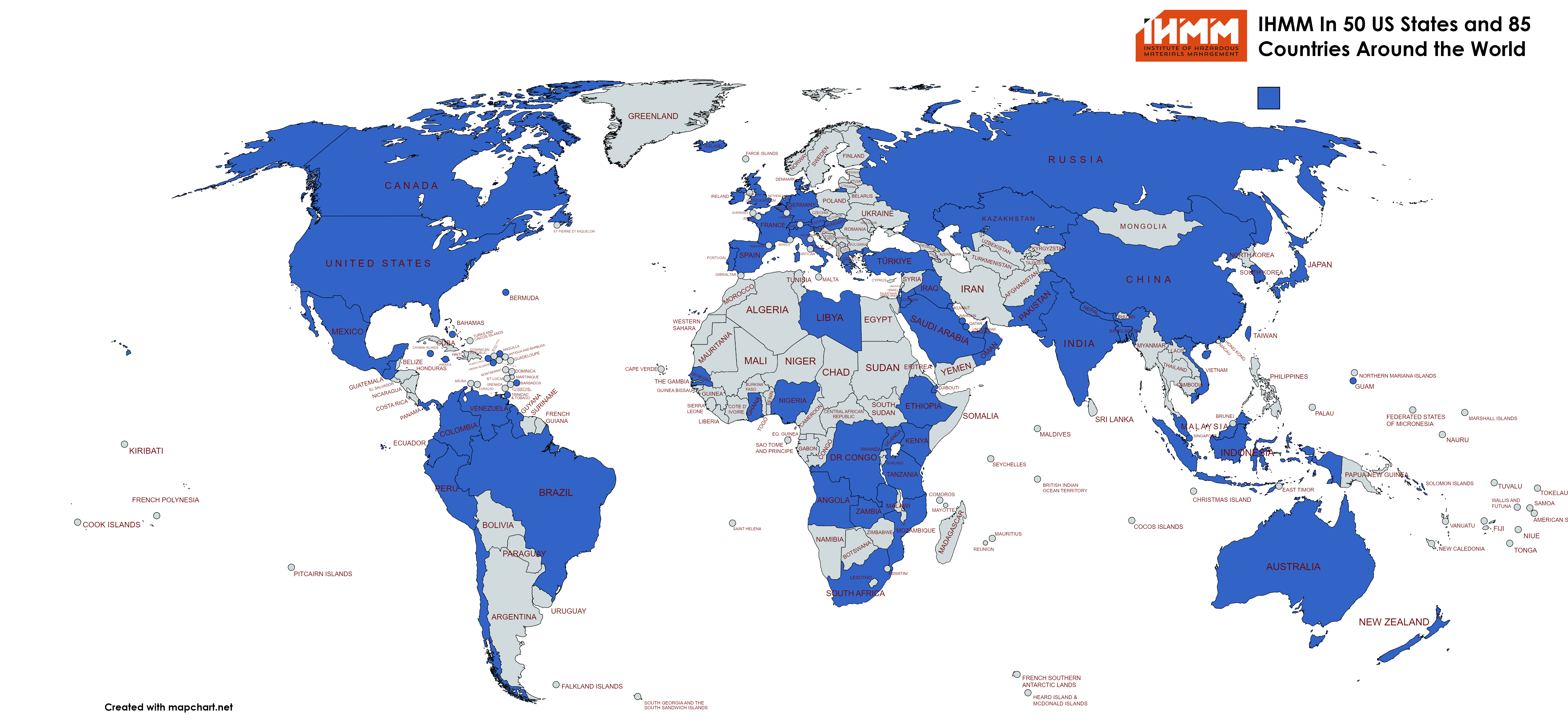
This momentum is more than just numbers; it’s a testament to our unwavering mission. Every day, across 50 states and 85 countries, IHMM champions the critical role of its credentialed professionals, setting standards of excellence in environmental, health, and safety fields. Together, we are shaping the future—one message, one connection, one breakthrough at a time!
8,387,532
IHMM Salary Survey Results
IHMM is pleased to release the survey of salaries underlying the hazardous materials/dangerous goods credentials salaries by job title, as well as the survey of salaries underlying the workplace safety credentials salaries by job title. You may download these surveys as linked below.

IHMM launched its “Open to Work” online COLLABORATION community exclusively for IHMM certificants looking to connect, share resumes, and discover job opportunities together in a supportive environment.
You can find this community after logging into COLLABORATION here: https://community.ihmm.org/home
Sean Grady, CHMM – Environmental Transformation Podcast

Sponsored Content
#1 – Recertification Video
#2 Recertification Video
IHMM Recertification Videos
Congratulations. After hard work and dedication, you earned your professional credential. Now, every 5 years, you will need to recertify your valuable credential. Over 5 years, you need to earn 200 certification maintenance points or CMPs. You receive 100 CMPs for the job you perform, and then need to earn a minimum of another 100 CMPs in a variety of ways, demonstrating your commitment to continuous improvement and remaining current with the demands of your profession and our communities of practice.
Considering everything you did to achieve certification, don’t let it go to waste by failing to recertify.
Upholding Integrity: The Updated IHMM Code of Ethics
At IHMM, integrity isn’t just a principle—it’s the foundation of everything we do. Our Code of Ethics is the guiding standard for all IHMM Certificants, ensuring that professionals in hazardous materials, dangerous goods, environment, health, and safety uphold the highest levels of honor, trust, and responsibility in their work.
By committing to this Code, Certificants reinforce their dedication to excellence, ethical conduct, and public safety. Violating these standards isn’t an option—those who do may face disciplinary action from a peer review panel, including credential suspension or revocation.
We’ve recently updated our Code of Ethics to reflect evolving industry standards and best practices. Stay informed, stay accountable, and continue leading with integrity.
📜 Explore the updated IHMM Code of Ethics here: IHMM Code of Ethics
🎥 Watch the latest Code of Ethics video below!
IHMM Mentors Support

Welcome to the Future of Professional Growth with IHMM’s Mentoring Program!
Are you ready to take your career to the next level? Dive into a world of opportunity and advancement with IHMM’s dynamic mentoring program! Our experienced mentors are here to share their expertise, offer personalized guidance, and help you navigate both credential exams and everyday work challenges.
✨ Unlock Your Potential: Learn from industry leaders and accelerate your professional journey. ✨ Tailored Support: Receive personalized advice and strategies to overcome your unique challenges. ✨ Build Connections: Join a vibrant community of professionals eager to support and inspire each other.
Whether you’re a newcomer in the field or seeking to hone your skills, IHMM’s mentoring program is your gateway to growth and success. Stay tuned for inspiring stories, valuable tips, and exclusive insights from our mentors!
Embark on a journey of discovery and achievement with us. Welcome aboard!
IHMM’s Collaboration platform contains a “Mentor Match” module [see below at right] that allows mentors to signup designating the hours, number of mentees, subject areas, and length of time they wish to mentor – as well as enabling mentees signup requesting assistance in specified areas. The mentor match module does the rest by matching mentors and mentees.
IHMM Government Affairs
Regulatory Updates
| 12/09/2025 | Pipeline Safety: Minimum Random Drug Testing Rate for Calendar Year 2026 | Notice | |
| 12/05/2025 | Hazardous Materials: Notice of Actions on Special Permits | Notice | |
| 12/05/2025 | Hazardous Materials: Notice of Applications For Modification to Special Permits | Notice | |
| 12/05/2025 | Hazardous Materials: Notice of Applications for New Special Permits | Notice | |
| 12/04/2025 | Hazardous Materials: Modernizing Regulations To Facilitate Transportation of Hazardous Materials Using Highly Automated Transportation Systems | Proposed Rule | 171, 172, 173, 174, 175, 176, 177, 178 |
IHMM Files Comments on EPA NPRM National Emission Standards for Hazardous Air Pollutants From Hazardous Waste Combustors: Residual Risk and Technology Review; Withdrawal of Proposed Revisions to Standards for Periods of Malfunction
The Institute of Hazardous Materials Management [IHMM] filed comments in EPA’s NPRM Docket ID No. EPA–HQ–OAR–2004–0022, Comments on Proposed NESHAP for Hazardous Waste Combustors—Residual Risk and Technology Review; Withdrawal of Proposed Revisions to Standards for Periods of Malfunction (90 Fed. Reg. 50814, Nov. 10, 2025.
IHMM addressed the statutory and best practices elements of this proposed rule from the perspective of IHMM’s CHMMs and CHMPs, and the comments include a comprehensive compliance-risk matrix of how the proposed rule affects the work of CHMMs and CHMPs.
IHMM also made recommendations to the EPA concerning state-level implementation guidance implementing the proposed revisions to the Hazardous Waste Combustor (HWC) NESHAP resulting from EPA’s Residual Risk and Technology Review (RTR).
As IHMM does with all comments on any agency’s proposed rules, we also highlighted the background and experience of CHMMs and CHMPs by including the credential blueprints of each and outlining the recertification, continuing education, and accreditation standards of IHMM’s credentials. As we want all government agencies to know about our credentials, this background information is an integral part of all of IHMM’s comments in the hazmat, dangerous goods, and safety EHS areas of interest.
IHMM Government Relations Actions in 2025
Coalitions
IHMM participated in the following coalitions during 2025.
- American Society of Association Executives [ASAE] Advocacy Council
- Community Impact Coalition in Washington
- The Workplace EHS Coalition (formerly known as the Intersociety Forum)
- Professional Certification Coalition
- Tomorrow’s Workforce Coalition
Coalition Letters to Congress and the President
- IHMM, Workplace EHS Coalition, Write to Congressional appropriators concerning OSHA/NIOSH funding
- IHMM, Workplace EHS Coalition Write to Congressional appropriators and the President on the critical importance of prioritizing worker safety in the federal budget
- IHMM, ISF Letter to Congress on the Government Shutdown
- IHMM, ISF Advocacy for U.S. Chemical Board Funding
- IHMM NSC Coalition Letter to Congressional Appropriators
- 460 Friends of NIOSH Coalition Letter Here
- Read the final SWANA End of Life Op-Ed here
- OSHA 25-Member Coalition Letter Here
- Here is the Intersociety Forum “Driving Business Growth and Profitability Through Modern Occupational Environmental, Health and Safety Practices” document [Sept 2025].
Comments Filed in Federal Regulatory Actions
- Perfluoroalkyl and Polyfluoroalkyl Substances (PFAS) Data Reporting and Recordkeeping Under the Toxic Substances Control Act (TSCA); Revision to Regulation – IHMM Comments Filed December 8, 2025
- National Emission Standards for Hazardous Air Pollutants From Hazardous Waste Combustors: Residual Risk and Technology Review; Withdrawal of Proposed Revisions to Standards for Periods of Malfunction – Due 12/26
- EPA – National Emission Standards for Hazardous Air Pollutants – IHMM Comments Filed November 16, 2025
- OSHA – Construction Illumination – IHMM Comments Here Filed October 26, 2025
- OSHA – Amending the Medical Evaluation Requirements in the Respiratory Protection Standard for Certain Types of Respirators – IHMM Comments Here Filed October 14, 2025
- OSHA – Interpretation of the General Duty Clause: Limitation for Inherently Risky Professional Activities – IHMM Comments Here Filed October 14, 2025
- DOT – Hazardous Materials: Remove Redundant List of U.S. EPA CERCLA Hazardous Substances – IHMM Comments Filed August 28, 2025
- DOT – National Freight Strategic Plan 2025 Update: Request for Information – IHMM Comments Filed August 14, 2025
- PHMSA – PHMSA’s ANPRM: Mandatory Regulatory Reviews – IHMM Comments Here Submitted August 1, 2025
- US DOT Regulatory Information Request –IHMM Comments Here Filed May 5, 2025
- OSHA Proposed Heat Rule – IHMM Comments Here Filed January 13, 2025
Tomorrow’s Workforce Coalition Legislation Signed Into Law
After modifications in the Senate to win over Sen. Murkowski (R-AK) and the removal of a few provisions deemed invalid by the Parliamentarian, the Senate passed their version of H.R. 1: To provide for reconciliation pursuant to title II of H. Con. Res. 14 on Tuesday, July 1, 2025. The House then passed the Senate-amended version of HR 1 on Thursday, July 3, 2025.
The President signed that legislation into law on Friday, July 4, 2025.
What Is a “529” Plan and How Does It Work?
On July 4, 2025, President Trump signed into law legislation created by the Tomorrow’s Workforce Coalition, of which IHMM is a part, that expands the permissible uses of an IRS 529 plan to include certain expenses relating to acquiring and maintaining a professional certification.
An IRS 529 plan is a tax-advantaged savings vehicle designed to encourage saving for future education costs. Named after Section 529 of the Internal Revenue Code, these plans are administered by states or educational institutions and offer tax benefits to the contributor and beneficiary when used for qualified education expenses.
PHMSA – ANPRM HM-266 – Highly Automated Transport Systems – CHMMs and CDGPs
Synopsis of ANPRM — PHMSA: Modernizing Hazardous Materials Regulations for Highly Automated Transportation Systems
Deadline: March 4, 2025
Agency:
U.S. Department of Transportation (DOT), Pipeline and Hazardous Materials Safety Administration (PHMSA). Federal Register Public Inspection
Action:
Advance Notice of Proposed Rulemaking (ANPRM) inviting stakeholder input on potential revisions to the Hazardous Materials Regulations (HMR; 49 C.F.R. Parts 171–180) to address the transportation of hazardous materials using highly automated transportation systems. Federal Register Public Inspection
Docket No. / RIN:
Docket PHMSA-2024-0064 (HM-266); RIN 2137-AF68. Federal Register Public Inspection
Purpose:
PHMSA seeks comments to inform a future Notice of Proposed Rulemaking (NPRM) concerning how the existing HMR should be modernized to safely and effectively accommodate the emerging use of highly automated transportation systems (HATS) in the movement of hazardous materials. This includes evaluating whether current regulatory provisions, developed with traditional human-operated conveyances in mind, pose safety ambiguities or operational impediments in automated contexts. Federal Register Public Inspection
Important Stories for IHMM Certificants
Environmental News for This Week
Since December 23, 2025 to this week, federal environmental regulation continued a pronounced deregulatory trajectory with several high-impact developments bearing legal and compliance risk.
The Environmental Protection Agency’s ongoing proposed redefinition of “Waters of the United States” (WOTUS) remained front and center. Under the proposal, the agency would sharply narrow federal Clean Water Act jurisdiction, potentially excluding the vast majority of wetlands and ephemeral streams from federal protection — leaving approximately 87 % of Wisconsin wetlands and up to 96 % of Ohio wetlands and streams outside federal oversight. This proposal has significant implications for permitting obligations, enforcement exposure, and state-federal jurisdictional interplay.
EPA also advanced modifications to the PFAS reporting rule under TSCA, proposing expanded exemptions — including de minimis concentration and imported articles exclusions — that could reshape manufacturer reporting obligations.
These regulatory actions occur against a backdrop of broader agency direction noted by observers as prioritizing fossil-fuel interests and reduced pollution limits enforcement, further complicating compliance landscapes.
Implications for regulated entities include reassessment of CWA permitting strategies, increased reliance on state regimes, evaluation of PFAS reporting exposures, and heightened litigation risk from environmental and state challengers.
Workplace Safety News This Week
During the final weeks of 2025 and into early 2026, the most consequential U.S. workplace-safety issue has been OSHA’s active regulatory and compliance posture following the federal government shutdown, emphasizing clarifications of enforcement expectations and resumed enforcement operations. OSHA issued seven Letters of Interpretation (LOIs) in late December 2025, which do not create new rules but legally clarify how existing safety and health standards apply in real-world contexts (e.g., confined spaces, recordkeeping, powered industrial trucks, carcinogen controls, hearing conservation, stairway design). These LOIs signal OSHA’s enforcement intent and assist employers in aligning compliance programs with current agency interpretations — a crucial legal reference point in inspection defense and risk mitigation.
Concurrently, OSHA resumed normal enforcement operations post-shutdown and extended contest periods for citations issued during shutdown days, effectively tolling contest deadlines and giving employers additional time to respond, dispute, or seek informal conferences regarding citations.
These agency actions demonstrate OSHA’s dual focus on clarifying compliance expectations and ensuring procedural fairness after a period of enforcement interruption. For legal counsel and safety professionals, the issuance of LOIs and administrative deadline adjustments constitute the most significant workplace-safety developments in this period, shaping enforcement outcomes and compliance strategies nationwide.
Below are the OSHA Letters of Interpretation (LOIs) topics issued in late December 2025 that are most relevant to EHS professionals, CHMMs, CHMPs, CSHMs, CSMPs, and AHMMs—i.e., your industry and credentialing ecosystem—flagged with why they matter legally and operationally.
OSHA Interpretation Topics of Highest Relevance (Dec. 23, 2025–Jan. 4, 2026)
1. Confined Spaces (29 CFR 1910.146)
Why it matters:
OSHA clarified employer responsibilities for hazard evaluation and rescue planning in non-permit and permit-required confined spaces. This directly affects industrial facilities, utilities, labs, and energy operations.
Risk: Misclassification of spaces → serious or willful citations; post-incident liability exposure.
2. Recordkeeping & Injury/Illness Classification (29 CFR Part 1904)
Why it matters:
Clarifications on when injuries must be logged, how to treat restricted duty, and employer responsibility for temporary workers.
Risk: Inaccurate OSHA 300/300A logs → enforcement exposure, credibility issues during inspections, and litigation discovery risk.
3. Powered Industrial Trucks (29 CFR 1910.178)
Why it matters:
OSHA addressed operator training, certification, and workplace-specific hazard assessments.
Risk: Forklift incidents remain a top OSHA fatality driver; training gaps often trigger multi-item citations.
4. Hearing Conservation & Noise Exposure (29 CFR 1910.95)
Why it matters:
Clarification on monitoring requirements and when audiometric testing is mandatory.
Risk: Long-latency occupational illness claims; cumulative compliance failures.
5. Stairways, Walking-Working Surfaces, and Egress (29 CFR 1910 Subpart D)
Why it matters:
OSHA clarified design and maintenance expectations—highly relevant to warehouses, manufacturing, and labs.
Risk: Slip/trip/fall citations; repeat violations increasingly escalated.
6. Carcinogens & Hazard Communication
Why it matters:
Clarifications reinforce employer duty to evaluate exposure, labeling, and training—even when substances are present intermittently.
Risk: Chemical exposure claims; alignment with TSCA, RCRA, and lab safety obligations.
Strategic Takeaway for IHMM-Aligned Professionals
These interpretations collectively signal that Occupational Safety and Health Administration is tightening expectations around documentation, training, and hazard evaluation—without issuing new rules. For credential holders, these LOIs should be treated as de facto enforcement guidance, incorporated into training, audits, exam blueprints, and compliance SOPs.
Global DG Transport Regulatory Update
IHMM Global DG Transport Compliance Matrix (2025–2026)
IHMM Certificant Compliance Checklist
Weeks of December 15, 2025-January 4, 2026
I. Executive Overview
The period between December 15, 2025 and January 4, 2026 marks a regulatory inflection point rather than a rulemaking surge in global dangerous-goods transportation law. With ADR 2025 fully in force, IMDG Code Amendment 42-24 transitioning toward mandatory status, and the UN Model Regulations revision cycle advancing, regulators worldwide have shifted from promulgation to implementation, enforcement prioritization, and preparation for the next amendment cycle.
Across jurisdictions, the dominant themes during this period are:
(1) enforcement maturation, particularly for batteries and undeclared DG;
(2) operational consolidation of 2025-level instruments; and
(3) forward-looking positioning for 2026–2027 amendments under UN and UNECE auspices.
II. United States — Enforcement Policy as the Primary Driver of Change
A. PHMSA Enforcement Posture Solidifies
No new amendments to 49 C.F.R. Parts 171–180 were issued during this period. Nevertheless, U.S. DG regulation evolved materially through enforcement practice rather than statutory text. The Pipeline and Hazardous Materials Safety Administration (PHMSA) continued operationalizing its data-driven inspection and enforcement framework, announced in late November.
During the closing weeks of 2025 and into early January 2026, PHMSA field activity reflected sustained focus on:
Lithium-ion and sodium-ion batteries, including battery-powered vehicles and equipment;
Cylinder manufacturing and requalification facilities;
Undeclared or misdeclared hazardous materials, particularly in parcel and e-commerce channels; and
Repeat violators, identified through historical inspection data.
Legal Significance
From a legal perspective, PHMSA’s approach confirms that enforcement policy now functions as a de facto regulatory instrument. Even in the absence of new HMR text, U.S. shippers—especially exporters—are expected to meet UN Model Regulations and ADR-aligned standards for classification, packaging, documentation, and training. Failure to do so increasingly exposes regulated parties to enforcement action and downstream liability.
III. Europe — ADR 2025 Fully Embedded; ADR 2027 in Early Formation
A. ADR 2025 Enforcement and Interpretation
Throughout this period, ADR 2025 (ECE/TRANS/352) was fully operational across Contracting Parties, with national authorities focusing on inspection, clarification, and compliance normalization rather than amendment. Authorities issued guidance and reminders addressing:
Application of new battery-related UN entries, including sodium-ion batteries;
Revised provisions for waste and asbestos transport;
Vehicle and equipment requirements under ADR Part 9, particularly for alternative propulsion systems; and
Continued validity of ADR driver training certificates under Chapter 8.2.
B. Early Signals for ADR 2027
Simultaneously, work continued quietly on the ADR 2027 amendment cycle. Delegations within the UNECE Working Party on the Transport of Dangerous Goods are developing concepts relating to:
DG carriage by battery-electric and hybrid heavy vehicles;
Regulation of reverse-logistics and returned DG flows;
Refinement of limited quantity (LQ) provisions; and
Enhanced treatment of undeclared DG in small-parcel and e-commerce distribution.
Legal Significance
For European operators and international shippers, this period underscores that ADR compliance is no longer transitional. ADR 2025 represents the settled baseline, while contractual arrangements and compliance systems must remain adaptable to anticipated tightening in ADR 2027, particularly in battery- and e-commerce-driven supply chains.
IV. Asia — Regulatory Quiet, International Standards Ascendant
A. Limited National Rulemaking
Between mid-December and early January, no major national DG transport statutes or regulations were promulgated in key Asian jurisdictions.
B. Carrier and Port-Driven Compliance
Despite limited domestic legislative activity, Asian shippers and carriers experienced rising compliance expectations driven by:
Ongoing work of the UN Sub-Committee of Experts on the Transport of Dangerous Goods, which is shaping future UN Model Regulations;
Widespread carrier adoption of IMDG Code Amendment 42-24 practices ahead of its mandatory date; and
Uniform application of ICAO Technical Instructions / IATA Dangerous Goods Regulations 2025–2026 for air transport.
Legal Significance
In Asia, compliance risk is increasingly determined by international carrier acceptance standards rather than domestic law alone. For legal counsel, UN- and ADR-aligned documentation and packaging now constitute the operative standard of care, even where national legislation has not yet been updated.
V. Africa — Gradual Alignment Through Practice Rather Than Statute
A. Absence of New DG Legislation
No African jurisdiction enacted a major DG-specific statute during this period. National frameworks remain diverse and often embedded within general transport or hazardous-substance laws.
B. Practical Convergence with UN/ADR Norms
Notwithstanding legislative quiet, African ports, customs authorities, and carriers increasingly:
Require DG documentation consistent with UN classification and numbering;
Apply maritime acceptance criteria aligned with IMDG 42-24; and
Subject battery and hazardous-waste consignments to heightened scrutiny.
Legal Significance
For multinational operators, Africa exemplifies a broader trend: practice is converging toward UN/ADR standards ahead of formal legislation. Operational non-compliance may therefore result in shipment refusal or delay even where domestic statutes appear permissive.
VI. Central & South America — MERCOSUR Stability, National Enforcement Emphasis
A. Regional Framework Remains Unchanged
At the regional level, the MERCOSUR Agreement on the Land Transport of Dangerous Goods, as modernized by CMC Decision 15/2019, remained the controlling instrument throughout this period. The agreement continues to be expressly tied to revisions of the UN Model Regulations.
B. National Implementation and Enforcement
More significant were national-level developments:
Argentina continued intensified inspections of battery-powered equipment and vehicles under its UN-aligned implementation framework;
Brazil advanced internal guidance clarifying application of UN entries—particularly sodium-ion batteries—under ANTT Resolution 5.998/2022; and
Colombia moved from transition to active enforcement of its dangerous-goods transport registry, imposing concrete reporting and traceability obligations.
Legal Significance
Although MERCOSUR provides a harmonized technical baseline, compliance risk in South America is increasingly national and enforcement-driven. Shippers must ensure alignment with each country’s implementing measures and inspection practices, not merely the regional agreement.
VII. Overall Assessment
For the period December 15, 2025 through January 4, 2026, global DG transport regulation is characterized by:
Enforcement-led change without new statutory text (United States, South America);
Full consolidation of ADR 2025 as the European baseline;
Ongoing international norm-setting under UN and UNECE bodies; and
Rising carrier- and port-driven compliance expectations (Asia and Africa).
Across all regions, battery technologies, hazardous waste, and undeclared DG remain the dominant regulatory pressure points.
VIII. Conclusion
The close of 2025 and opening of 2026 confirm a central reality of dangerous-goods law: regulatory risk increasingly arises from enforcement, interpretation, and international harmonization rather than headline legislation alone.
For IHMM certificants and DG professionals, the prudent course is to treat ADR 2025, the UN Model Regulations, IMDG Code Amendment 42-24, and ICAO 2025–2026 as the global standard of care, irrespective of jurisdiction. Documentation, packaging approvals, training programs, and contractual controls should be reviewed accordingly as organizations position themselves for the 2026–2027 amendment cycle.

Perspectives On Prevention in Action
Planning Proactively for School Safety
Starting the year with intentional planning helps schools address challenges before they arise. “This time at the beginning of the school year gives us maybe a little bit of an opportunity to think about the year ahead and try to be a little proactive with our planning,” Emily Torres noted. Taking time to review procedures, clarify roles, and strengthen school-community partnerships helps ensure everyone understands their role in maintaining safety. Proactive planning also allows schools to refresh safety conversations with students and staff.
Centering Mental Health and Relationships
School safety extends beyond physical security. Strong relationships and attention to mental health lay a foundation for prevention and recovery. Emily emphasized that “we all have a role to play in school safety, from reminding students about those interactions to making sure that all staff in our school buildings… families and our other adults in the community as well… see this as part of their role.” Implementing trauma-informed practices supports students and staff, creating an environment where concerns are noticed early and addressed effectively.
Engaging Students as Partners
Students play an active role in promoting safety. Co-director Marc Zimmerman remarked, “Building on that, it’s also getting the students involved…they feel ownership, and they help create solutions that actually work.” Whether through peer-led initiatives, safety committees, or informal discussions, elevating student voice strengthens school climate and encourages reporting of concerns.
To watch the entire Spotlight video or explore related resources, click here.
_______
External Opportunities
1/21/26 – Enhancing School Safety Using Behavioral Threat Assessment
Hosted by the U.S. Secret Service
2/18/26 – Preventing Mass Attacks in Our Communities
Hosted by the U.S. Secret Service
3/18/26 – Enhancing School Safety Using Behavioral Threat Assessment
Hosted by the U.S. Secret Service
4/15/26 – Preventing Mass Attacks in Our Communities
Hosted by the U.S. Secret Service
5/20/26 – Enhancing School Safety Using Behavioral Threat Assessment
Hosted by the U.S. Secret Service

Recent News from the European Chemicals Agency
- Highlights from December RAC and SEAC meetings
- Assessment of regulatory needs reports published
- PFAS draft opinion consultation: guidance for respondents and detailed mapping of uses
- Call for evidence: restriction of PPDs and PDs in rubber tyres
- Screening report published for DOTE and Reaction mass of DOTE and MOTE
- Member State Committee December meeting highlights
- Consultations on harmonised classification and labelling
- New intention and proposals to harmonise classification and labelling
- Consultation on a candidate for substitution and derogation to exclusion criteria
- Fall observed in hazardous chemical trade in 2024
- New web pages on our tasks under the Industrial Emissions Directive
- REACH registration data and C&L Inventory only available in ECHA CHEM
- From science to safety: PBT Expert Group discussed bioaccumulation assessment strategies
- Webinar material and Q&As available
- Call for evidence and public consultation: Evaluation of Biocidal Products Regulation


News from IHMM Affiliates
Alliance of Hazardous Materials Professionals
IHMM is affiliated with AHMP and is pleased to bring this important information to all of our certificants.
AHMP News
- 2026 EHS HAZMAT Summit, September 29 – October 1 in New Orleans, Louisiana.
- Exhibit booths and sponsorship opportunities are open: Learn more
- Call for Abstracts is open! Join us as a presenter in 2026
AHMP Webinars
- Join us on January 22 at 3:30 pm Eastern for a Webinar: Rechargeable Lithium Ion Batteries– Most rechargeable batteries are safe—but some pose hidden risks. This webinar, presented by Ben Hissam, covers how to identify batteries that may fail, catch fire, or explode; the types of rechargeable batteries on the market; and how thermal runaway occurs. The presentation focuses on e-mobility devices and common home and workplace items, and includes tips for protecting yourself and avoiding hazards from improper disposal. Learn More & Register
American Industrial Hygiene Association
IHMM is affiliated with AIHA and is pleased to bring this important information to all of our certificants.
The Synergist
A Structured Approach to Public Policy
By Larry Sloan
Given AIHA’s diverse membership and broad range of interests, organizing our public policy efforts can be a challenge. How do we ensure our activities are grounded in members’ experiences? How do we prioritize the many issues that have potential to affect the OEHS profession? What policy problems should our volunteers focus on?

National Safety Council
IHMM is a member of the National Safety Council and is pleased to bring this important information to all of our certificants.
NSC News
- Prevent carbon monoxide exposure at work: new webinar
- ‘Self-certification has to go,’ FMCSA leader says
- ‘Long COVID and Workplace Safety’: New report from NSC
- OSHA highlights its 2025 letters of interpretation
- Effective Jan. 1: amendments to Minnesota’s rest and meal break laws
- NSC to offer free traffic safety training to employers in four states
NSC Webinars
- Jan 8 – OSHA Training for General Industry: Key Training Elements of the Most Common Safety Topics
- Jan 13-16 – Safety Training Methods – ASC Virtual 4-Day Course : 01/13/26 – 01/16/26 Session
- Jan 15 – Beyond the Safety Department: Scaling EHS Expertise to Every Frontline Decision
- Jan 15 – Incident Investigation – ASC Virtual One-Day Course : 01/15/26 Session
- Jan 16 – Job Safety Analysis – ASC Virtual One-Day Course : 01/16/26 Session
- Jan 28 – Safety Inspections – ASC Virtual One-Day Course : 01/28/26 Session
- Jan 29 – Team Safety – ASC Virtual One-Day Course : 1/29/26 Session
- Jan 29 – The HazCom Compliance Clock is Ticking! Here’s How to Meet Updated Requirements
- Feb 16-19 – Safety Training Methods – ASC Virtual 4-Day Course : 02/16/26 – 02/19/26 Session
- Feb 23-27 – Fundamentals of Industrial Hygiene – ASC Virtual 5-Day course : 02/23/26 – 02/27/26 Session
- Feb 26 – Safety Inspections – ASC Virtual One-Day Course : 02/26/26
American Society of Safety Professionals
IHMM is a member of the American Society of Safety Professionals and is pleased to bring this important information to all of our certificants.
ASSP News
- Episode 177: Providing Effective Training to Every Generation of the Workforce
- Why ISO 45001 is the Global Game-Changer for Every Safety Professional
- Episode 176: Working on the Night Shift – What Safety Pros Need to Know
- The Impact of Giving Back
- Episode 175: Using Predictive Analytics to Help Prevent Incidents in Your Workplace
- After the Shutdown: How Safety Professionals Can Keep Momentum Strong
ASSP Webinars
- Jan 29 – Stand-Up for Standards: Ask the Chairs – Z16.1 Key Metrics That Drive Impact
- Feb 13 – Stand-Up for Standards: Understanding the Revised ANSI Z490.1 Training Standard
- Feb 19 – Integrating Z10 to Manage Occupational Health & Safety
- Feb 19 – Accident Investigation Techniques
- Feb 26 – Safety Management II
- Feb 26 – Enterprise Risk Management for Safety Professionals
- Feb 26 – ANSI/ASSP Z16: Using Safety Metrics to Drive Operational Excellence
- Feb 26 – Influential Leadership Skills
- Feb 26 – Risk Assessment and Management for Safety Professionals
- Feb 26 – Integrating ISO 45001 to Manage Occupational Health & Safety
- Feb 26 – Safety Management I
- Feb 26 – Corporate Safety Management
Coming Soon…
The Certified Professional
From the IHMM Foundation | Highlighting Our Commitment to Professional Development | Scholarships | Research | Affinity Programs | Networking |
IHMM and The IHMM Foundation
Check it out! The graphic to the left brings to life the powerful partnership between IHMM and the IHMM Foundation — a collaboration built to support YOU and every IHMM credential holder!
IHMM created the IHMM Foundation with one goal in mind: to empower and elevate its certificants. While IHMM delivers a wide range of prestigious professional credentials, the IHMM Foundation steps in with game-changing professional development programs designed to support both current certificants and those on the path to certification.
Together, they’re building a stronger, smarter, and more connected community of professionals. 🚀 Ready to take your career to the next level? This is where it all begins!


9210 Corporate Boulevard, Suite 470
Rockville, Maryland, 20850
www.ihmm.org | [email protected]
Phone: 301-984-8969 | Fax: 301-984-1516